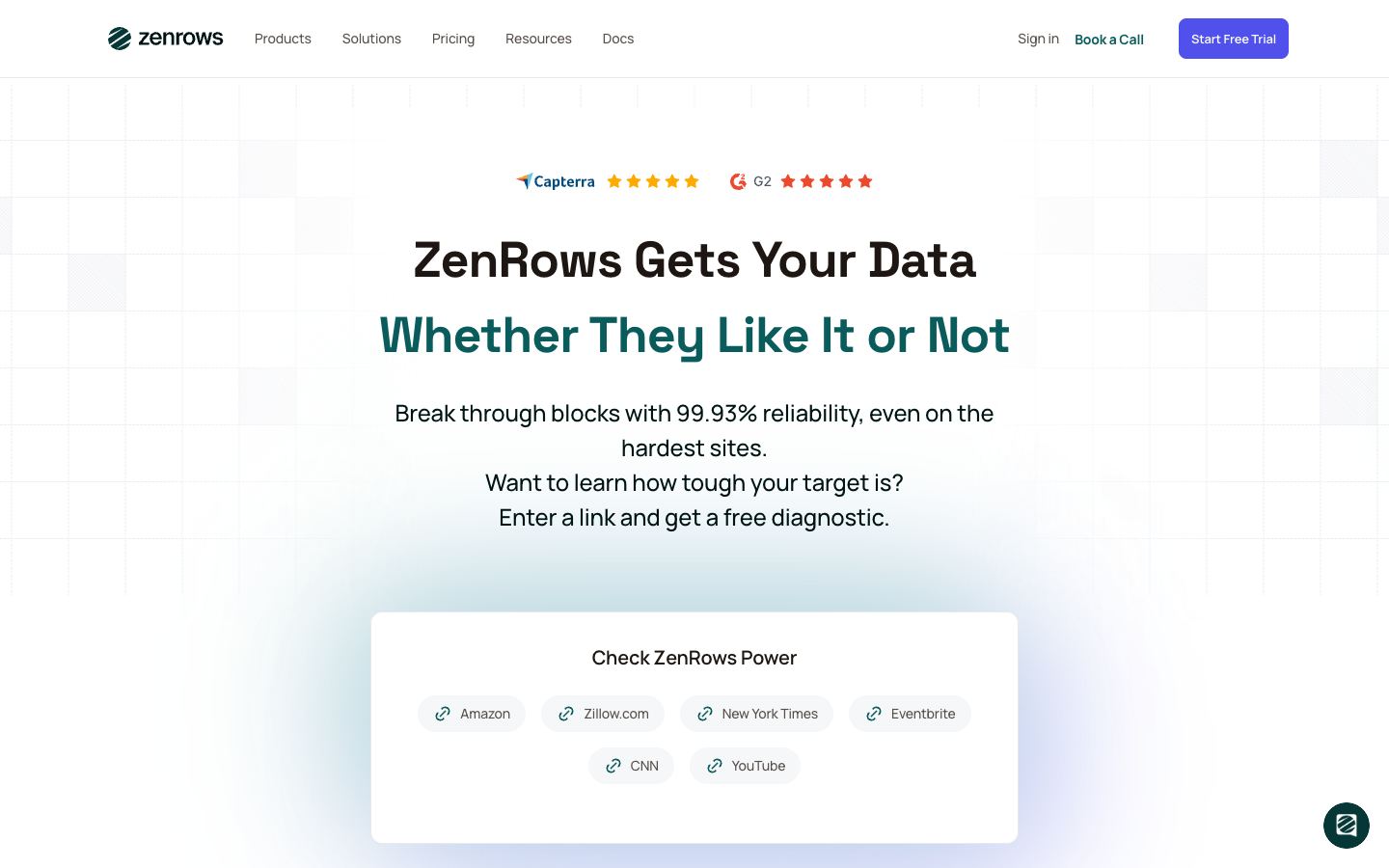
Gets scrapers past CAPTCHAs, fingerprinting, and WAF blocks
Each tool is evaluated against our methodology using public docs, vendor demos, and hands-on testing.
Some links on this page are affiliate links. We earn a commission if you sign up – at no additional cost to you. Our editorial assessment is independent and never paid. How we review.
What is ZenRows?
Scraping API specialized in anti-bot bypass – CAPTCHAs, browser fingerprinting, and WAF circumvention.
Our verdict
If your target sites are heavily protected (Cloudflare, Akamai, PerimeterX), ZenRows is the specialist. It performs well on hard targets, though independent benchmarks vary widely on where its success rate actually ranks.
Premium pricing reflects the anti-bot expertise. For sites without heavy protection, you're paying for capabilities you don't need. Use the right tool for the job.
Categories:
Web scraping APIs abstract away the hardest parts of web data collection: JavaScript rendering, anti-bot detection, proxy rotation, and data parsing. Instead of building and maintaining your own scraping infrastructure, you send a URL and receive clean, structured data back. For AI applications, many of these APIs now return LLM-ready markdown or structured JSON.
Handles proxy rotation and JS rendering behind one scraping API
Freemium·Mar 2026·Web Crawl & Data Extraction APIs
Anti-detection scraping API with CAPTCHA solving at low cost
Freemium·Mar 2026·Web Crawl & Data Extraction APIs
How ZenRows compares
ScraperAPIScraperAPI offers better value for straightforward scraping without heavy anti-bot needs.
ScrapelessScrapeless is a newer competitor also focusing on anti-detection at potentially lower cost.
Frequently asked questions
How much does ZenRows cost?
ZenRows is a paid API with a time-limited free trial rather than a permanent free tier. The trial gives you a small usage allowance to test the API before you pay. Paid plans start with a Developer tier and scale up through Business tiers into custom Enterprise pricing. Billing is success-based, so you are charged only for requests that succeed. Cost per request varies because JavaScript rendering and premium proxies apply multipliers against your monthly balance, which makes heavily protected targets more expensive to scrape than simple pages.
Is ZenRows open source or self-hostable?
No. ZenRows is a closed-source, hosted API. There is no public codebase to inspect and no self-hosted deployment option, so every request routes through ZenRows infrastructure. If running the scraper inside your own environment or auditing the source code is a hard requirement, ZenRows will not meet it. You reach its anti-bot, proxy, and rendering features only through the managed endpoints.
What is ZenRows best at?
Anti-bot bypass. ZenRows is built to reach sites behind Cloudflare, Akamai, and PerimeterX, and it handles CAPTCHAs, browser fingerprinting, and WAF challenges through one API call. It also renders JavaScript and can return structured output. The clearest fit is targets with heavy protection where simpler scraping APIs keep failing. On lightly protected pages you are paying for capability you may not need.
How does ZenRows compare to ScraperAPI?
Both are hosted scraping APIs with proxy rotation and JavaScript rendering, and neither is open source. ScraperAPI is the broader, lower-cost generalist for high-volume scraping across many sites. ZenRows leans toward the harder anti-bot cases and prices accordingly. Pick ScraperAPI when most of your targets are lightly protected and cost per request matters most. Pick ZenRows when specific sites keep blocking you despite a generalist tool.
When should I choose Scrapeless over ZenRows?
Scrapeless is the alternative worth weighing if ZenRows pricing feels high for your volume. Both target protected sites with managed rendering and proxies, and neither is self-hosted. Consider Scrapeless when you want to compare success rates and per-request cost on your own target list before you commit. Keep ZenRows in the running when its anti-bot success on your hardest sites justifies the premium over a cheaper option.