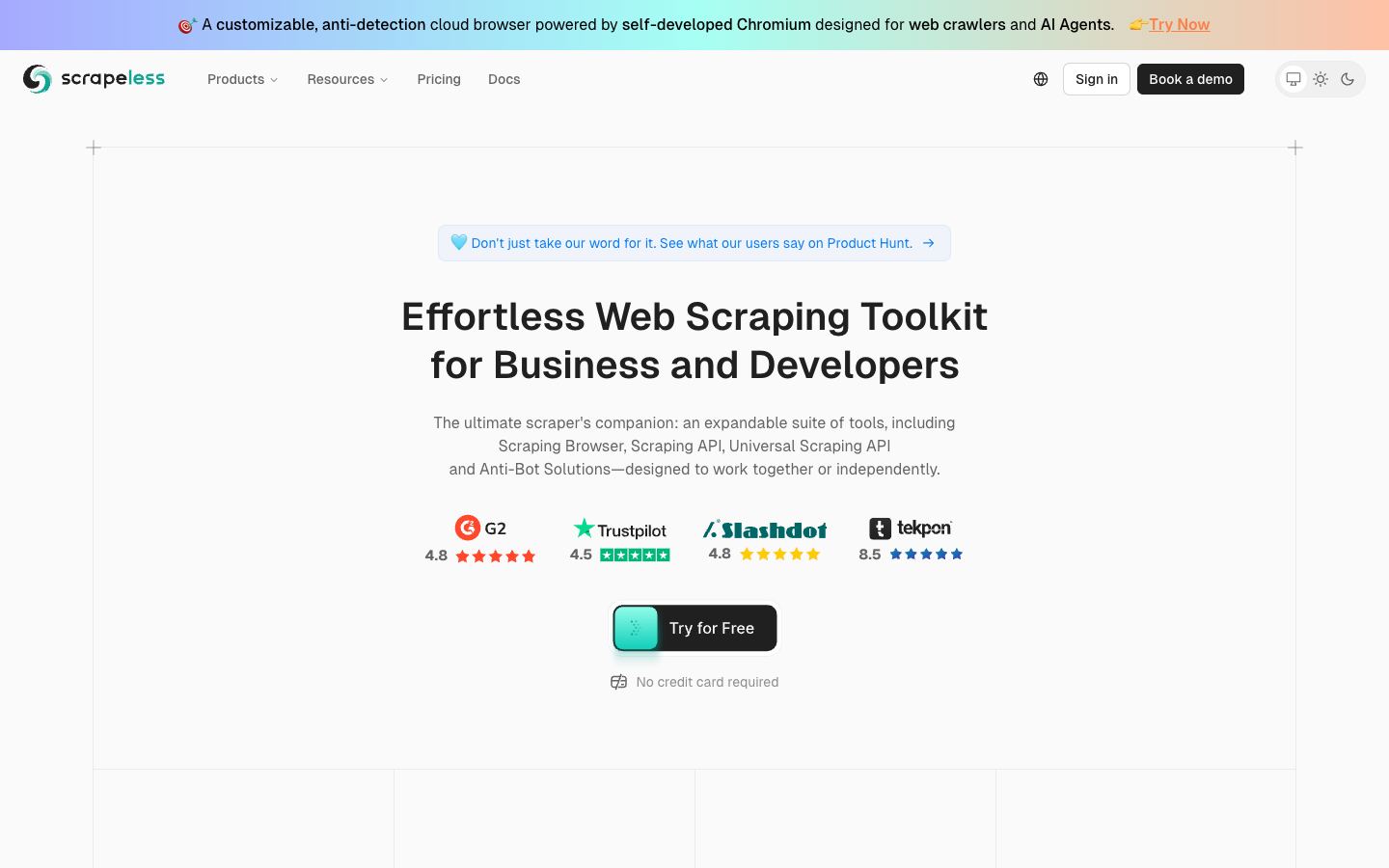
How much does Scrapeless cost?
Scrapeless is freemium, so you can start without paying and move to paid plans as usage grows. It positions itself on competitive pricing, with heavily protected targets and CAPTCHA-bound requests generally costing more than simple pages. Custom enterprise terms are available through sales. Check the pricing page for current rates and tiers, since published numbers shift over time and the live page is the only reliable source.
Is Scrapeless open source or self-hostable?
No. Scrapeless is a hosted, closed-source web data extraction API. There is no public source repository and no self-hosted deployment, so you cannot run it inside your own infrastructure. You send requests to its endpoints and it handles proxies, anti-detection, and CAPTCHA solving on its side. If running the scraper inside your own environment is a hard requirement, an open-source framework or a self-hostable tool fits better.
Does Scrapeless handle JavaScript rendering and anti-bot systems?
Yes. Scrapeless renders JavaScript, so it can fetch content from client-side pages, and it returns structured output. Its headline focus is anti-detection: anti-fingerprinting and CAPTCHA solving aimed at a high success rate against anti-bot defenses. These features are solid for the product's maturity. It is a newer entrant with a shorter track record at scale than older APIs, so validate reliability on your own target sites first.
What is the best alternative to Scrapeless?
ZenRows is the closest alternative, with a comparable anti-bot bypass and JavaScript rendering focus plus a longer track record. ScraperAPI suits high-volume general scraping and has a free tier. Firecrawl fits teams feeding clean content to LLMs, since it returns markdown built for AI pipelines. ScrapingDog is a budget-oriented option. Pick ZenRows or ScraperAPI when proven reliability matters more than Scrapeless's newer anti-detection pitch.
What is Scrapeless best used for?
Scrapeless fits teams extracting data from sites with strong anti-bot protection and frequent CAPTCHAs, where rendering JavaScript and avoiding detection are the main hurdles. Because it is newer with a smaller community, it suits projects that can test it against their own sites before committing. For mission-critical pipelines that demand a long, proven reliability record, an older API is the safer starting point.
How does Scrapeless compare to ZenRows?
Both are hosted, closed-source APIs that render JavaScript and target anti-bot bypass. ZenRows has been on the market longer, with a larger community and more documented reliability, which lowers risk for production use. Scrapeless competes on anti-detection features and pricing but has a shorter track record. If you want a proven option, ZenRows is the safer pick. If CAPTCHA handling and pricing are decisive, trial Scrapeless on your own targets and compare success rates directly.