How much does Apify cost?
Apify is freemium. The free plan gives you a small monthly platform credit with no card required, and that credit resets each month rather than rolling over. Paid plans start with a Starter tier and run up through Scale and Business, each bundling a larger block of prepaid credit. On top of the plan you pay for usage in compute units, and some Store Actors add a per-result fee, so a heavy run can cost more than the base subscription suggests.
Is Apify open source?
The Apify platform is commercial, not open source, and you cannot self-host it. What is open source is Crawlee, Apify's separate scraping framework for JavaScript and Python. You can run Crawlee on your own infrastructure for free and pay Apify only when you want cloud hosting, scheduling, managed proxies, or the Actor marketplace. A common pattern is to prototype with Crawlee locally, then deploy to the platform.
What is Apify best used for?
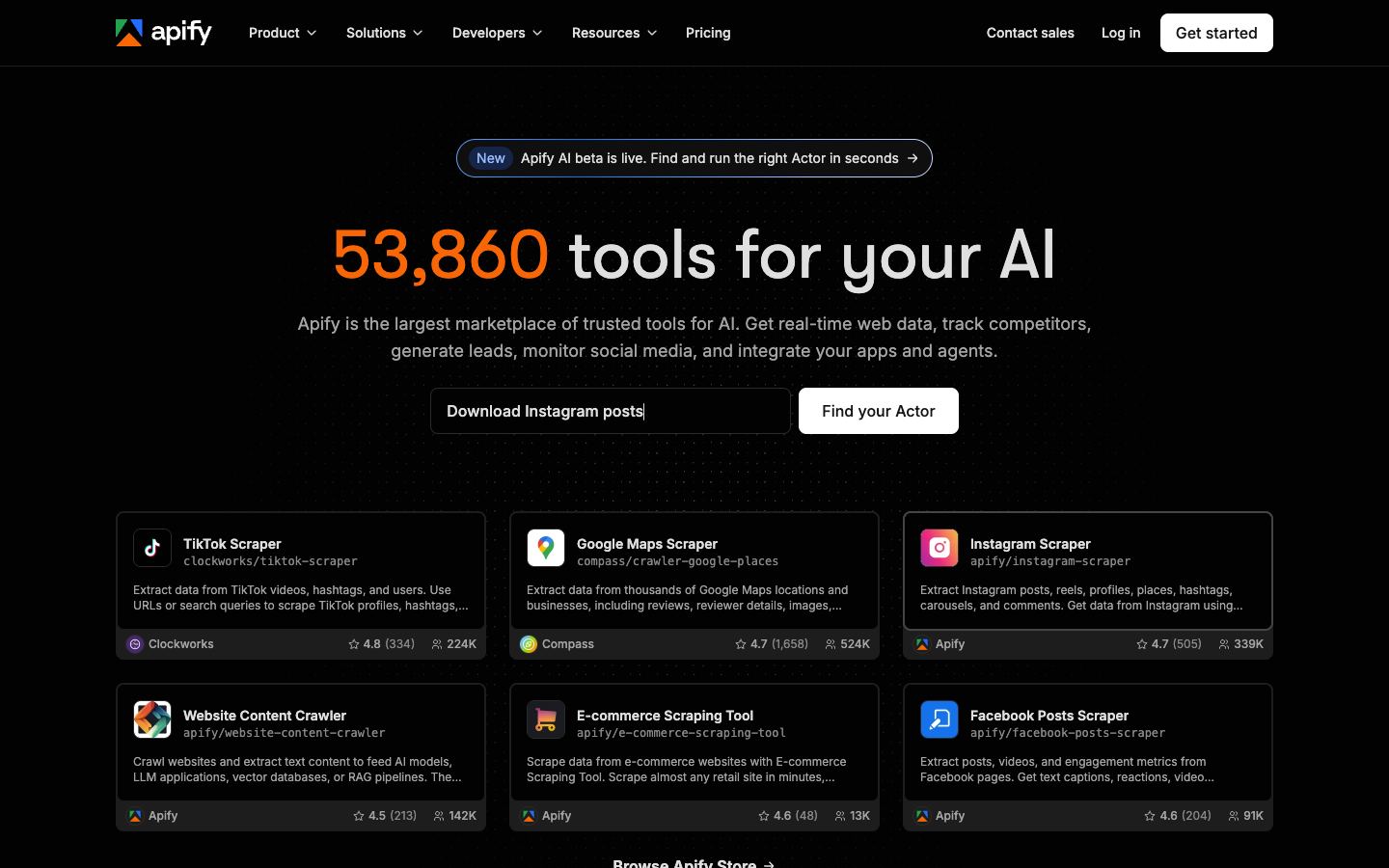
Apify suits teams that want a pre-built scraper instead of writing one. Apify Store holds 50,000+ Actors, so a scraper for your target site often already exists, handling JavaScript-heavy pages and returning structured output. It fits AI product builders who need data from many sources without maintaining scraping code. The tradeoff is learning the Actor model, plus watching compute costs, which climb if runs are not tuned.
How does Apify compare to Firecrawl?
Firecrawl is narrower. It focuses on turning web pages into clean, LLM-ready markdown or structured data through a simple API, which makes it quick to wire into an AI pipeline. Apify is a broader platform with an Actor marketplace, scheduling, storage, and proxies, and it can run complex multi-step crawls. Choose Firecrawl when you mainly want page content for a model. Choose Apify when you need a specific site scraper or heavier workflow orchestration.
What is the best alternative to Apify?
It depends on what you are optimizing for. Firecrawl is the closest fit for AI builders who want clean page content through a straightforward API. Zyte is the stronger option for large-scale enterprise extraction with managed anti-bot handling. Scrapy is the open-source route if you want to write and host your own crawlers without platform fees. Apify's edge is the ready-made Actor marketplace, so pick an alternative when that catalog is not the draw.