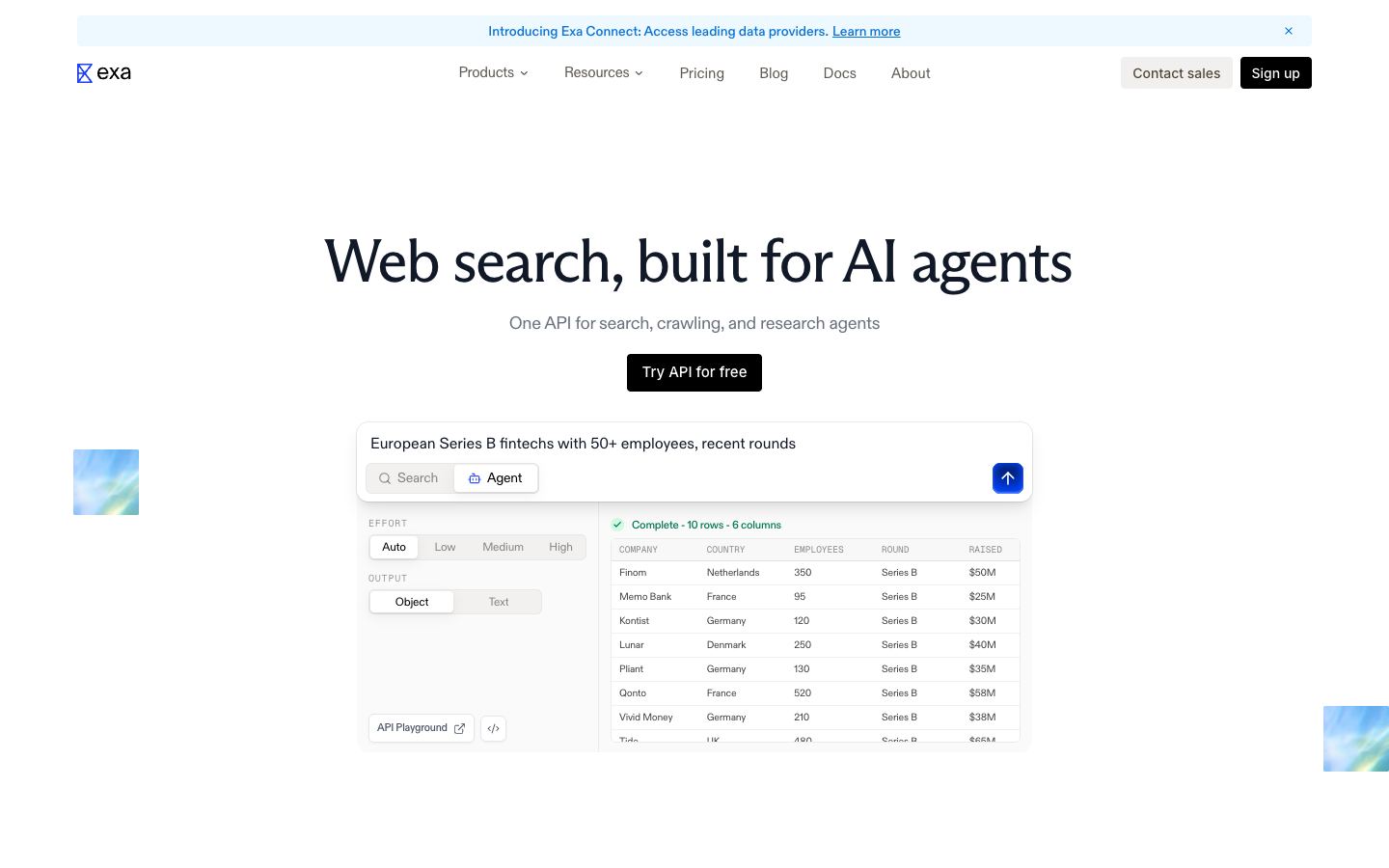
Embeddings-based neural search that finds semantically related pages
Each tool is evaluated against our methodology using public docs, vendor demos, and hands-on testing.
Some links on this page are affiliate links. We earn a commission if you sign up – at no additional cost to you. Our editorial assessment is independent and never paid. How we review.
What is Exa?
Neural search engine using embeddings-based next-link prediction – finds semantically similar content, not just keyword matches.
Our verdict
The most technically differentiated search API in the category. Embeddings-based retrieval surfaces results that keyword search misses entirely, which is why Cursor and AWS use it.
At ~$10M ARR with 1,010% YoY growth and a $2.2B valuation, execution is strong – but pricing at $7-15/1K queries adds up fast for high-volume agent workloads.
Categories:
AI search APIs are the infrastructure layer that gives large language models access to current web information. Unlike traditional search engines, these APIs return semantically relevant, structured results optimized for retrieval-augmented generation (RAG) and AI agent workflows. They are used by AI products that need to answer questions about the real world beyond their training data.
Real-time search API built for AI agents and RAG pipelines
Freemium·Mar 2026·AI-Native Search APIs
Composable web, news, and research search APIs for enterprise agents
Paid·Mar 2026·AI-Native Search APIs
API for the only independent Western search index at scale
Freemium·Mar 2026·Independent Web Indexes
How Exa compares
TavilyTavily is the direct competitor with broader LLM framework integrations, though now Nebius-owned.
You.comYou.com offers composable search APIs with more granular control over source types at enterprise scale.
Frequently asked questions
How much does Exa cost?
Exa uses pay-as-you-go pricing with no monthly minimum. Standard search runs $7 per 1K requests, with page contents for the first 10 results included; deep search is $12 per 1K, deep-reasoning search $15 per 1K, and the Answer endpoint $5 per 1K. The old keyword/neural tier split was retired in a March 2026 update. Sign-up includes $20 in free credits plus roughly $10 more each month, enough to evaluate the API end-to-end on a real workflow. Enterprise plans are negotiated separately with volume discounts.
Is Exa better than Tavily?
Exa wins on semantic discovery: its embeddings-based index surfaces conceptually similar pages that keyword search misses entirely, which is why Cursor and AWS use it. Tavily wins on LLM-framework integration breadth (LangChain, LlamaIndex) and price-per-query for straightforward web search. Choose Exa if you're building discovery-heavy agents; choose Tavily if you need plug-and-play RAG.
What is the Exa API used for?
Exa is used for AI agents that need to find semantically related web content rather than keyword matches – research agents, deep-research tools, similar-document discovery, and link-prediction features inside coding assistants. Its `findSimilar` endpoint is the most differentiated feature; competitors don't offer a comparable embeddings-native retrieval primitive.
Does Exa offer a free tier?
Yes. Exa gives $20 in free credits on sign-up, plus roughly $10 in credits each month, enough to evaluate the API end-to-end on a real workflow. Beyond the free credits it is pay-as-you-go with no monthly minimum: you pay per request by endpoint (search from $7 per 1K) and only for what you use.