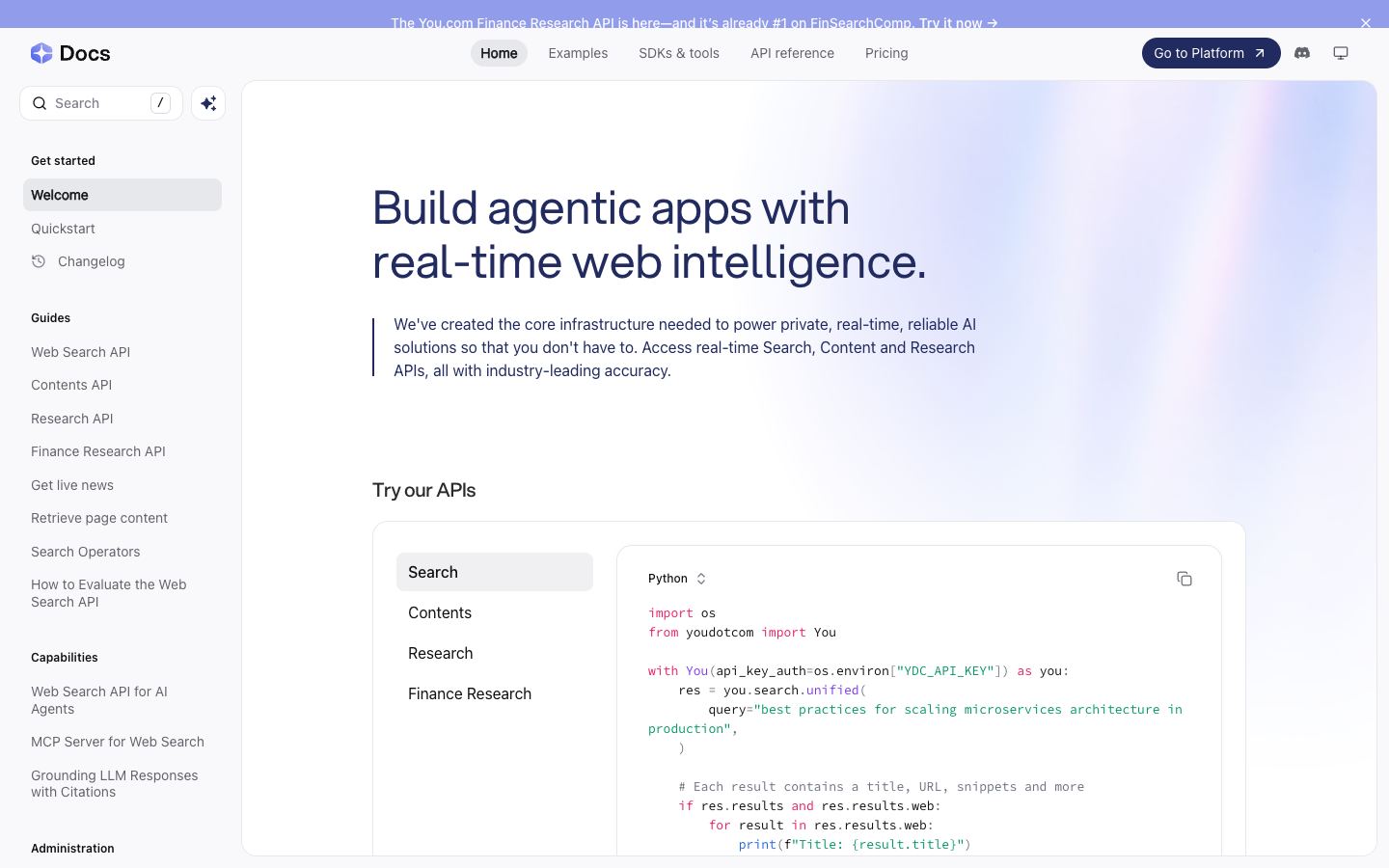
How does You.com price its API?
You.com is a paid service that charges per request, with published, self-serve rates: $5 per 1,000 web search calls (news included), $1 per 1,000 pages for its Contents API, and from $12 per 1,000 calls for its Research API. New accounts get $100 in free credits with no credit card required. Volume and enterprise terms can still be negotiated directly, so the practical cost depends on which endpoints you use and at what scale.
Is You.com open source or self-hostable?
No. You.com is a closed, hosted API. There is no public codebase to inspect and no option to run it on your own servers. You call its endpoints over the network and pay per request. If you need to host search on your own infrastructure or audit the underlying code, You.com will not fit, and an open-source retrieval stack is the better starting point.
Does You.com return structured output for LLM use?
Yes. You.com returns web results, news, and page contents in clean formats such as Markdown or HTML rather than raw browser pages. Its endpoints are split by function: web search, news, content retrieval, and deep research are separate calls. That lets you route each result type into a retrieval or agent pipeline directly, with little custom parsing on your side.
Does You.com render JavaScript or scrape live pages?
No. You.com is a search and content API in the AI search category, not a browser-based scraper. It does not render JavaScript or execute pages the way a headless browser does. It returns indexed search results and cleaned page content. For dynamic single-page apps or sites behind a login, pair it with a dedicated scraping or browser-automation tool.
What is You.com best used for?
You.com fits enterprise agent workloads that need real-time web and news search plus deep research at scale, with reported volumes above a billion API calls a month. Its separate endpoints suit teams building RAG systems or AI agents on fresh web data. Pricing is self-serve and competitive – $5 per 1,000 web search calls with $100 in free credits – so smaller teams and individual developers can start without a sales conversation, though the deep-research and finance endpoints cost more per call.
How does You.com compare to Exa?
Both are AI search APIs that return LLM-ready results. Exa centers on embeddings-based semantic search; You.com offers separate web, news, content, and deep-research endpoints with published, self-serve rates ($5 per 1,000 web search calls, undercutting Exa's roughly $7) and $100 in free credits. Pick Exa when embeddings-based relevance is the priority. Pick You.com when you want a wider set of endpoints, including deep and finance research, at a lower base search price.