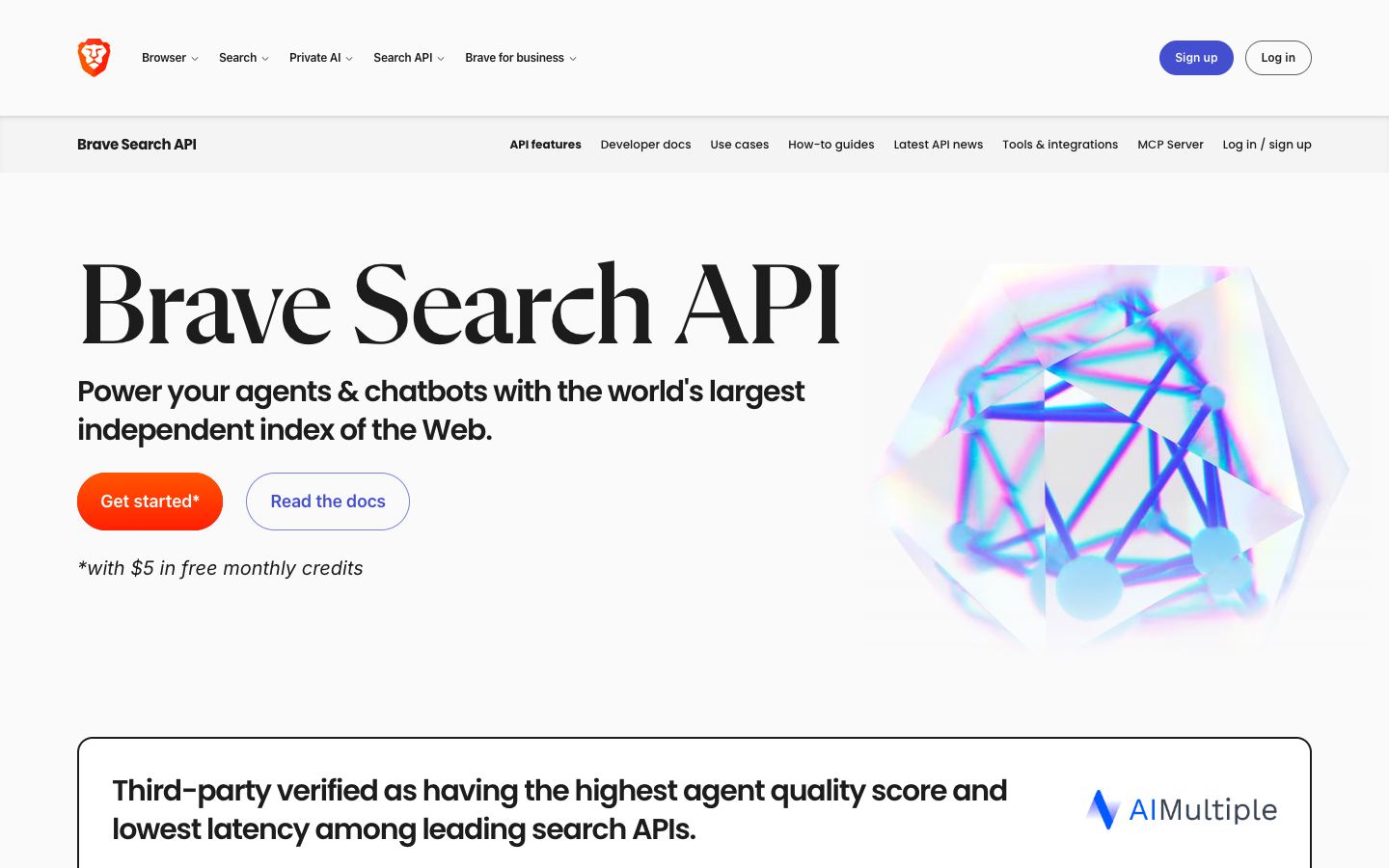
What is Brave Search API?
Programmatic access to the only independent Western search index at scale – 40B+ pages, adding or refreshing 100M+ pages daily.
Our verdict
After Microsoft retired the Bing Web Search API, Brave is the last independent Western search index of meaningful scale that still ships a public developer surface. 40B+ pages, ~100M added or refreshed daily, and a real consumer browser product feeding organic crawl signal that pure-API competitors lack. For any AI product that depends on web search, the question of whether your upstream provider can change terms unilaterally is no longer hypothetical – index ownership matters.
Two plans matter for AI builders. The Search Plan is $5 per 1,000 requests with 50 QPS and $5 in free monthly credits (~1,000 queries free). The Answers Plan combines search with LLM-generated answers at $4 per 1,000 requests plus $5 per million input/output tokens, capped at 2 QPS. That puts raw search at the high end of the category – Exa starts cheaper for keyword-style queries, Tavily bundles pre-extracted content into the per-call price – but neither runs its own index. The trade is: pay more, own the data path.
Best fit: agents that cite sources publicly, RAG pipelines that need a defensible corpus, and any product where a Bing-style API sunset would break your roadmap. Less ideal for embedding-heavy semantic retrieval (Exa is built for that) or workflows where you want extracted page content delivered with the search hit (Tavily's value prop). Worth piloting on real queries before committing – the index skews toward English-language and high-traffic sites, so coverage on long-tail non-English queries should be measured, not assumed.
Categories:
Independent web indexes maintain their own crawl of the web, separate from Google or Bing. This independence is valuable for AI applications that need unbiased search results, want to avoid rate limits on commercial search engines, or need specialized coverage. Several of these indexes are open source, allowing full transparency into how results are ranked.