How much does Serply cost?
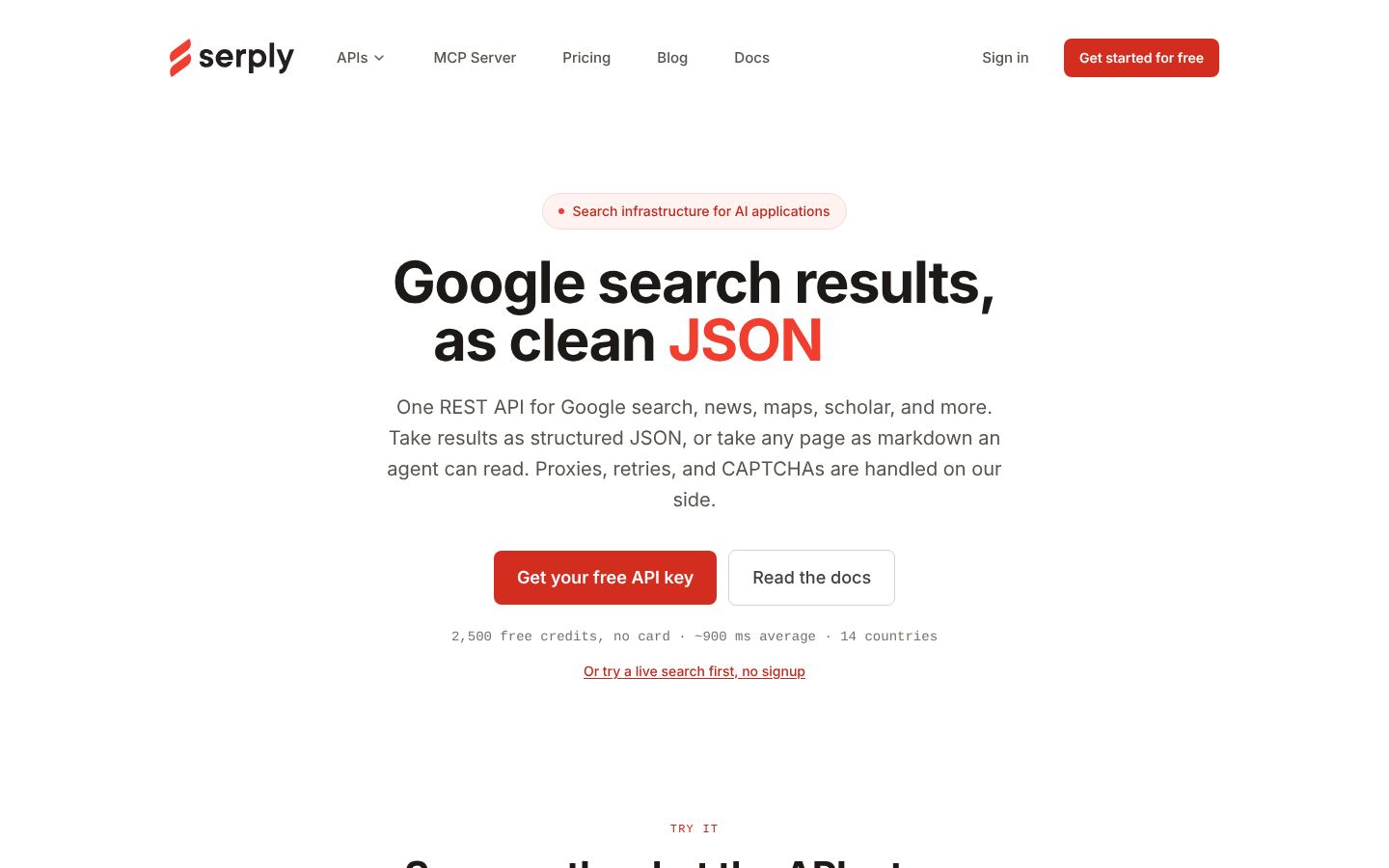
Serply uses prepaid credit packs, not a monthly plan. New accounts get 2,500 free credits, valid for 30 days, with no card required. Paid packs start at $5 for 2,500 credits, which works out to $2.00 per 1,000 requests, and fall to $0.98 per 1,000 on the 50,000-credit pack and $0.75 per 1,000 from 500,000 credits up. Purchased credits never expire, and cached responses are not charged.
Does Serply have an MCP server?
Yes. Serply runs a hosted MCP server, so you register one config entry instead of deploying anything. Clients with remote-server support, such as Claude Code and Cursor, connect over streamable HTTP; stdio-only clients connect through the mcp-remote bridge. Tools include Google search, Bing search, Google News, video and Scholar. Each tool call costs the same as the equivalent REST call: one credit per successful, uncached request.
Can Serply replace the Google Custom Search JSON API?
That is how Serply markets itself. Google has closed the Custom Search JSON API to new customers and says it ends on January 1, 2027. Serply returns Google results as JSON without a Programmable Search Engine ID, and its docs include a migration guide. Serply says most migrations come down to a new URL, a header for the key and a few renamed fields. Test result parity on your own queries before you switch.
Which search engines and result types does Serply support?
The core is Google: web search, News, Images, Video, Jobs, Scholar, Maps and Product (shopping) endpoints. Serply also covers Bing organic results with text and shopping ads, plus eBay search and Reddit, and a general request endpoint for fetching pages. Every endpoint costs one credit per successful call. It does not list Yahoo, Baidu, Yandex or Naver, so multi-engine rank tracking across those needs a different provider.
Is Serply open source or self-hostable?
No. Serply is a hosted, closed-source REST API. You send HTTPS requests with your key in a header and get JSON back; there is no code to inspect or run on your own servers. It works from any language that can make an HTTP request, and Serply lists SDKs in its docs, but the scraping and parsing happen on Serply's side. Teams with strict data-residency rules should check where requests are processed.
What is the best Serply alternative?
Serper.dev is the closest match: low-cost Google results on pay-as-you-go credits, with a bigger user base. SearchAPI.io makes sense if you need more engines or Google verticals than Serply offers. If you would rather not depend on scraped Google pages at all, Brave Search API queries Brave's own index. Compare a sample of your real queries on each, since price per 1,000 is close across all three.