How much does SearchAPI.io cost?
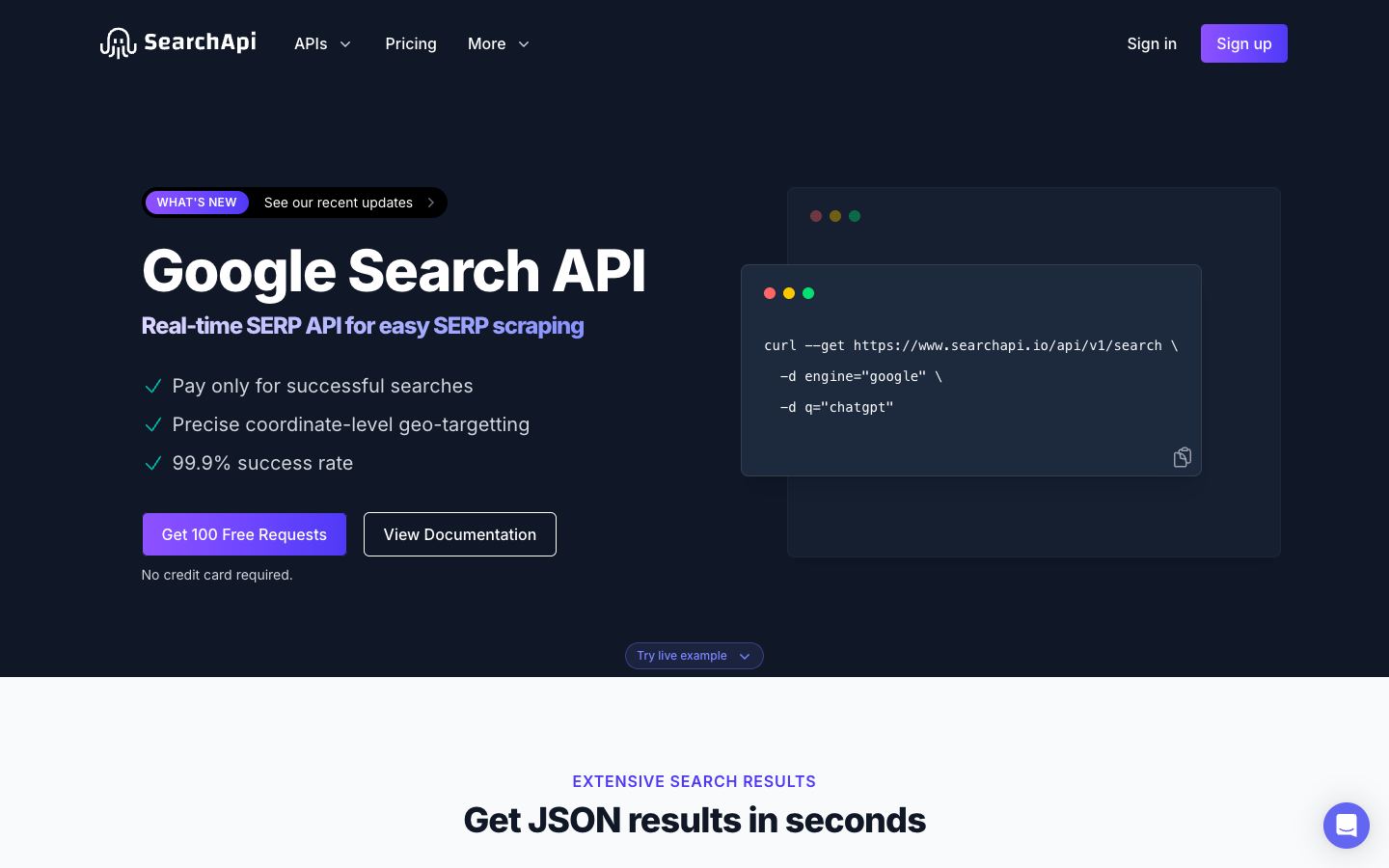
SearchAPI.io is freemium. There is a free tier you can try without a paid commitment, and billing runs on a pay-per-success model, so you are only charged for successful searches. Paid plans scale with monthly search volume, and the per-search rate drops as you move into higher tiers. Pricing changes over time, so check the pricing page for the current free allowance and the rate at the volume you expect to run.
Is SearchAPI.io open source or self-hostable?
No. SearchAPI.io is a hosted SaaS. It is not open source, and there is no self-hosted option. You call its API and it returns parsed results, but you cannot run the engine on your own infrastructure. It does ship open-source client integrations for tools like LangChain and Haystack. Those are connectors to the service. The scraping engine itself stays on the vendor's side.
Does SearchAPI.io render JavaScript and return structured data?
Yes. SearchAPI.io runs full browser rendering and executes JavaScript, so it handles dynamically loaded result pages instead of only raw HTML. Responses come back as structured JSON, parsed into fields like organic results, ads, knowledge graphs, and featured snippets. That structure is the main draw for builders feeding search results into an LLM pipeline, because you skip writing and maintaining your own parser for each engine.
What makes SearchAPI.io different from other SERP APIs?
Two things stand out. It advertises a legal protection guarantee with up to $2M in coverage for how it collects and parses public search data, which is unusual in a category facing active litigation. It also covers many engines beyond Google. One caveat: it grew out of the SerpAPI ecosystem, and SerpAPI sued its founder, so it carries the same open legal questions as the rest of the space.
What is the best alternative to SearchAPI.io and when should I choose it?
Serper.dev, DataForSEO, and Tavily are the main alternatives. Choose Serper.dev if you mainly need fast, cheap Google results and do not need wider engine coverage. Pick DataForSEO for high-volume SEO and rank-tracking work, where its per-call pricing and data breadth fit. Choose Tavily if your goal is feeding an LLM agent directly, since it returns results pre-shaped for retrieval rather than raw SERP fields.
How does SearchAPI.io compare to Tavily?
They target different jobs. SearchAPI.io is a general SERP API that returns structured results across many engines, useful when you need the actual search page data such as rankings, ads, and knowledge panels. Tavily is built for AI agents and returns output already shaped for retrieval-augmented generation. If you want raw, multi-engine SERP fields, choose SearchAPI.io. If you want results pre-digested for an LLM, Tavily fits more directly.