Is Scrapling free and open source?
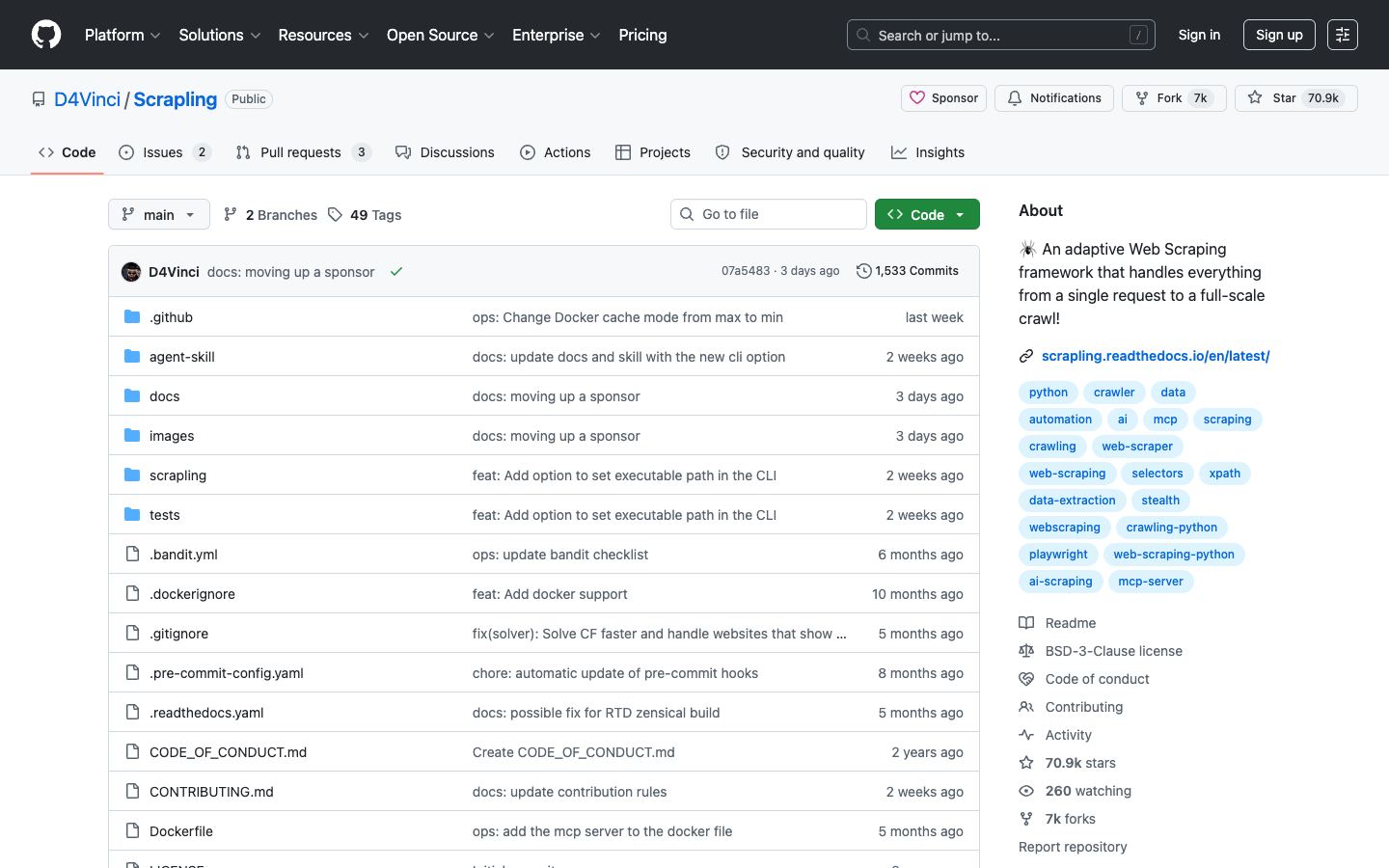
Yes. Scrapling is an open source Python library released under the BSD 3-Clause license, free to install with pip. There is no paid tier or commercial license. The project accepts optional sponsorship through donation links. Because it runs in your own Python process rather than as a hosted service, you carry no per-request or subscription cost, only the infrastructure you run it on.
Can Scrapling render JavaScript and bypass anti-bot systems?
Yes. Scrapling offers three fetcher modes: a basic HTTP fetcher, a dynamic fetcher that drives a real browser through Playwright to render JavaScript, and a stealth fetcher with fingerprint spoofing aimed at Cloudflare Turnstile and similar challenges. The browser modes handle client-side rendering and login sessions. Anti-bot bypass is never guaranteed against every site, but the stealth fetcher covers common protections out of the box.
Can Scrapling be self-hosted?
Scrapling is a self-hosted library by design. You install it with pip into your own Python environment and run it on your own machines, containers, or cloud functions. There is no vendor backend or API gateway between you and the target site, so your data and proxies stay under your control. The tradeoff is that you manage browser binaries, proxies, and scaling yourself instead of offloading them to a service.
How does Scrapling compare to Firecrawl?
They solve different parts of the problem. Firecrawl is a hosted API that returns clean, LLM-ready markdown from a URL and bills per request, so it removes infrastructure work. Scrapling is a self-run Python library with no usage fees but more setup. Choose Firecrawl when you want managed crawling for an AI pipeline without operating browsers. Choose Scrapling when you want full control, no per-request cost, and its adaptive selectors.
What is Scrapling best used for?
Scrapling suits teams writing their own Python scrapers that need to survive site redesigns. Its adaptive selector engine relocates elements after a page's structure changes using similarity matching, which cuts the maintenance that breaks brittle CSS or XPath rules. It fits recurring extraction jobs against sites that shift layouts often, or projects that need JavaScript rendering and stealth fetching in one library without paying for a hosted service.
What are the best alternatives to Scrapling?
The closest alternatives are Crawl4AI, Firecrawl, and ScrapeGraphAI. Crawl4AI is another open source Python library focused on producing LLM-ready output. Firecrawl and ScrapeGraphAI are hosted services that trade per-request pricing for less setup, with ScrapeGraphAI adding LLM-driven extraction. One caveat: Scrapling is maintained primarily by a single developer, so weigh that against the larger teams behind some alternatives before relying on it in production.