How much does Scrapfly cost?
Scrapfly is freemium. You can start free without a card, and there are paid monthly tiers that scale up for higher volume and enterprise use. Billing is credit-based on a shared pool across its products. A plain request costs the least, while JavaScript rendering and residential proxies cost more per call. So your real spend depends on which features you turn on rather than a flat per-request rate. Check the pricing page for current tier numbers.
Is Scrapfly open source or self-hostable?
No. Scrapfly is a closed-source, fully hosted API. There is no public source code to inspect and no self-hosted or on-premise option, so every request runs through Scrapfly's infrastructure and you depend on its uptime and proxy pool. If you need the scraping layer inside your own environment, Scrapfly is not the right fit and an open framework would suit you better.
Does Scrapfly render JavaScript?
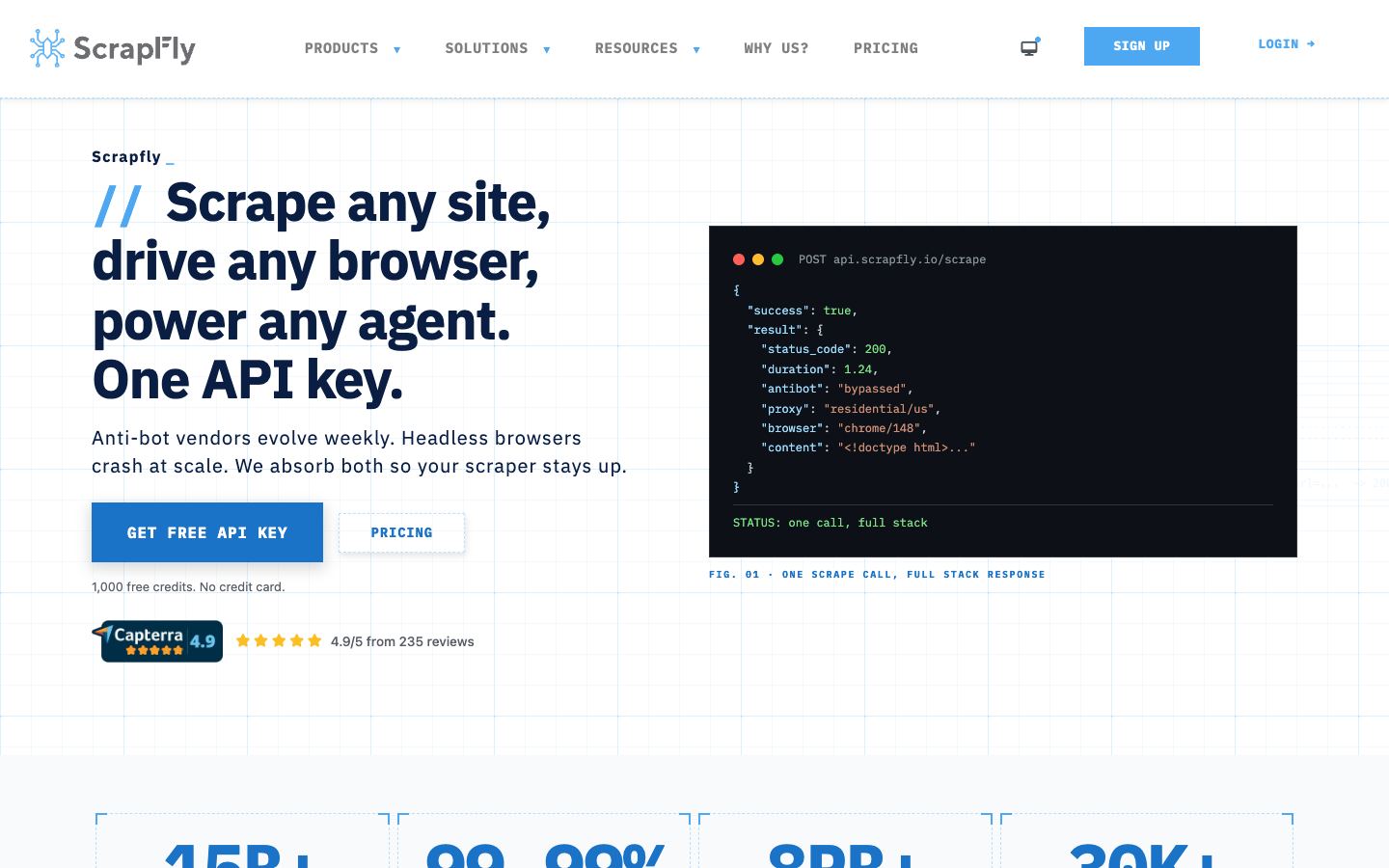
Yes. Scrapfly runs a cloud browser that executes JavaScript, so it can fetch content from single-page apps and sites that build the page client-side. It also handles anti-bot protection and can capture screenshots, which helps you confirm a page loaded as expected. One caveat: enabling JavaScript rendering uses more credits per request than a plain HTTP fetch, so it raises your effective cost.
What is the best alternative to Scrapfly?
ScraperAPI and ZenRows are the closest alternatives. Both are hosted scraping APIs with anti-bot handling and JavaScript rendering. ScraperAPI tends to be the volume-oriented choice with request-based pricing, while ZenRows leans on proxy rotation and bypass features. Scrapfly sits in similar territory without a sharp differentiator, so the decision usually comes down to pricing fit, documentation, and how each one performs against your specific target sites.
What is Scrapfly best used for?
Scrapfly fits teams that want a hosted web scraping API to handle proxies, anti-bot bypass, and JavaScript rendering without running that infrastructure themselves. The documentation is good and the screenshot feature helps confirm pages rendered correctly. It works as a mid-tier extraction layer for AI product builders pulling structured data from protected sites. Teams that need to self-host or want open-source control should look elsewhere.
How does Scrapfly compare to ZenRows?
Both are hosted scraping APIs with anti-bot handling and JavaScript rendering, and neither is open source or self-hostable. Scrapfly uses a shared credit pool across its products and adds screenshot capture, which ZenRows does not emphasize. ZenRows centers on proxy rotation and bypass for hard targets. The two are competent but similar, so test both against your actual target sites and compare effective cost per successful request before you commit.