How much does Zenserp cost?
Zenserp is freemium. There is a free tier for testing, and paid plans scale by monthly request volume, with a discount for annual billing. Published rates have shifted over time, and the lower-volume entry plans in particular tend to move, so check the pricing page at zenserp.com/pricing for the current per-tier numbers rather than relying on figures quoted elsewhere.
Is Zenserp open source or self-hostable?
No. Zenserp is a hosted, closed-source SERP API. You call its endpoints over HTTP and get back structured JSON. There is no source code to inspect and nothing to run on your own infrastructure. If you need search scraping to stay inside your own environment for compliance or data-residency reasons, Zenserp will not fit, and you would build against a self-managed scraping stack instead.
What makes Zenserp different from other SERP APIs?
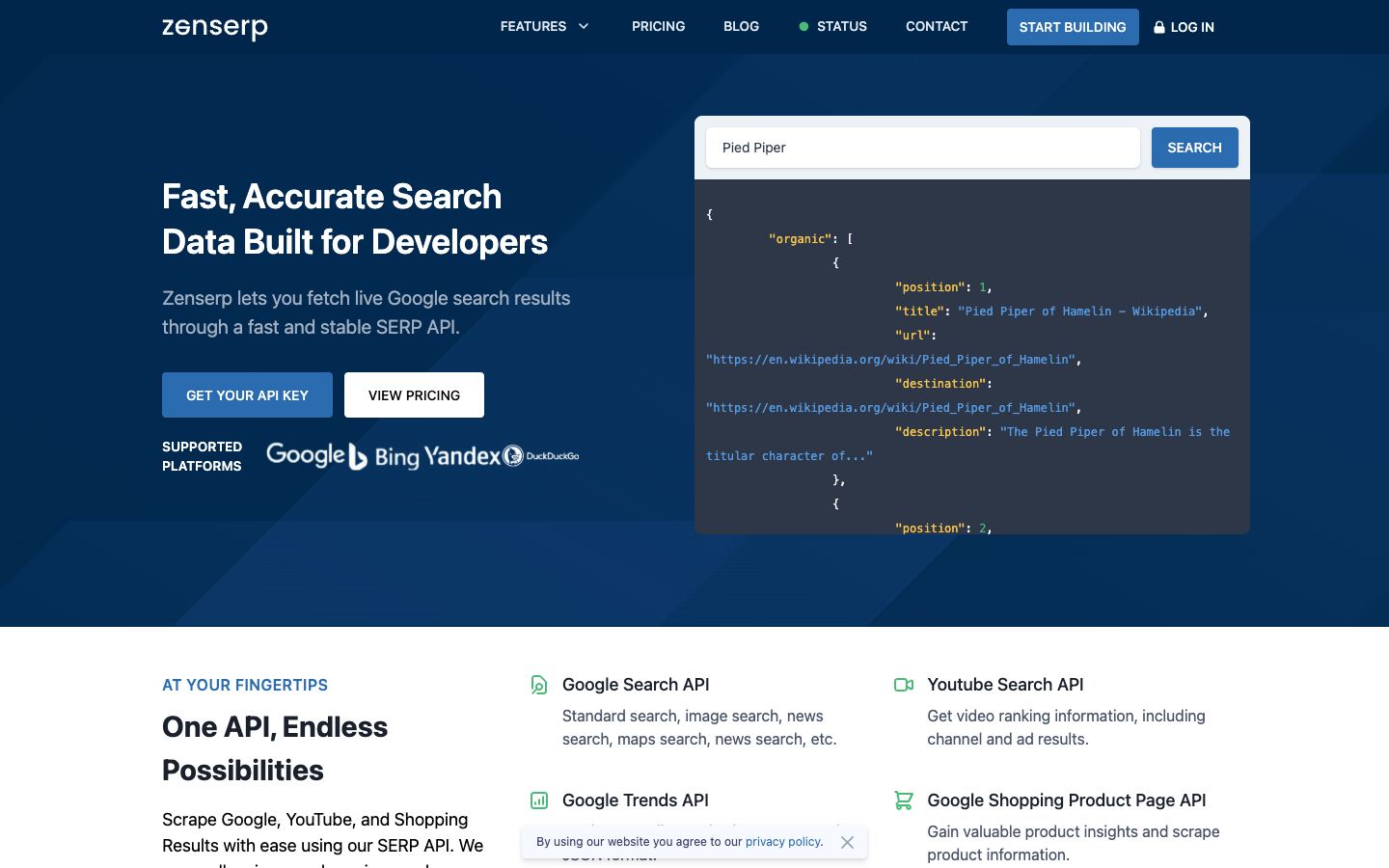
Zenserp supports Google image search and reverse image search through its API, which most SERP APIs skip in favor of web results only. That is its clearest reason to exist. It also returns real-time results, handles JavaScript rendering, gives structured JSON output, and supports batch processing. Outside the image search case, its core web SERP coverage overlaps heavily with larger, cheaper competitors.
When should I choose Zenserp over Serper.dev?
Choose Zenserp when you specifically need image search or reverse image search through an API, since Serper.dev is built around web, news, and standard SERP endpoints. For plain Google web results at scale, Serper.dev is the stronger default and prices aggressively at high volume. Zenserp is a smaller player, so for general SERP scraping there is little reason to pick it over Serper.dev.
What is Zenserp best used for?
Zenserp fits teams that need programmatic Google SERP data and, in particular, image or reverse image search results returned as structured JSON. Real-time queries and batch processing make it workable for rank tracking, monitoring, and dataset collection. It is a reasonable test candidate when image search is a hard requirement. For high-volume web-only SERP pulls, evaluate larger competitors such as Serper.dev or SerpAPI first on price and throughput.