How much does SerpAPI cost?
SerpAPI is a paid service with no permanent free plan beyond a small trial allotment for testing. Paid tiers are billed by the number of successful searches per month rather than a flat seat fee, and they scale up as your query volume grows. Higher tiers add more capacity and faster throughput for developer and large-data workloads. Pricing changes over time, so check serpapi.com/pricing for the current limits and rates before you commit.
Is SerpAPI open source or self-hostable?
No. SerpAPI is a closed-source hosted API. You cannot self-host it or run it inside your own infrastructure, and there is no public source repository to inspect or fork. You send requests to its endpoints and receive parsed results back over the network. If running scraping infrastructure on your own machines is a requirement, SerpAPI will not fit and you would need a different approach.
What search engines and data does SerpAPI support?
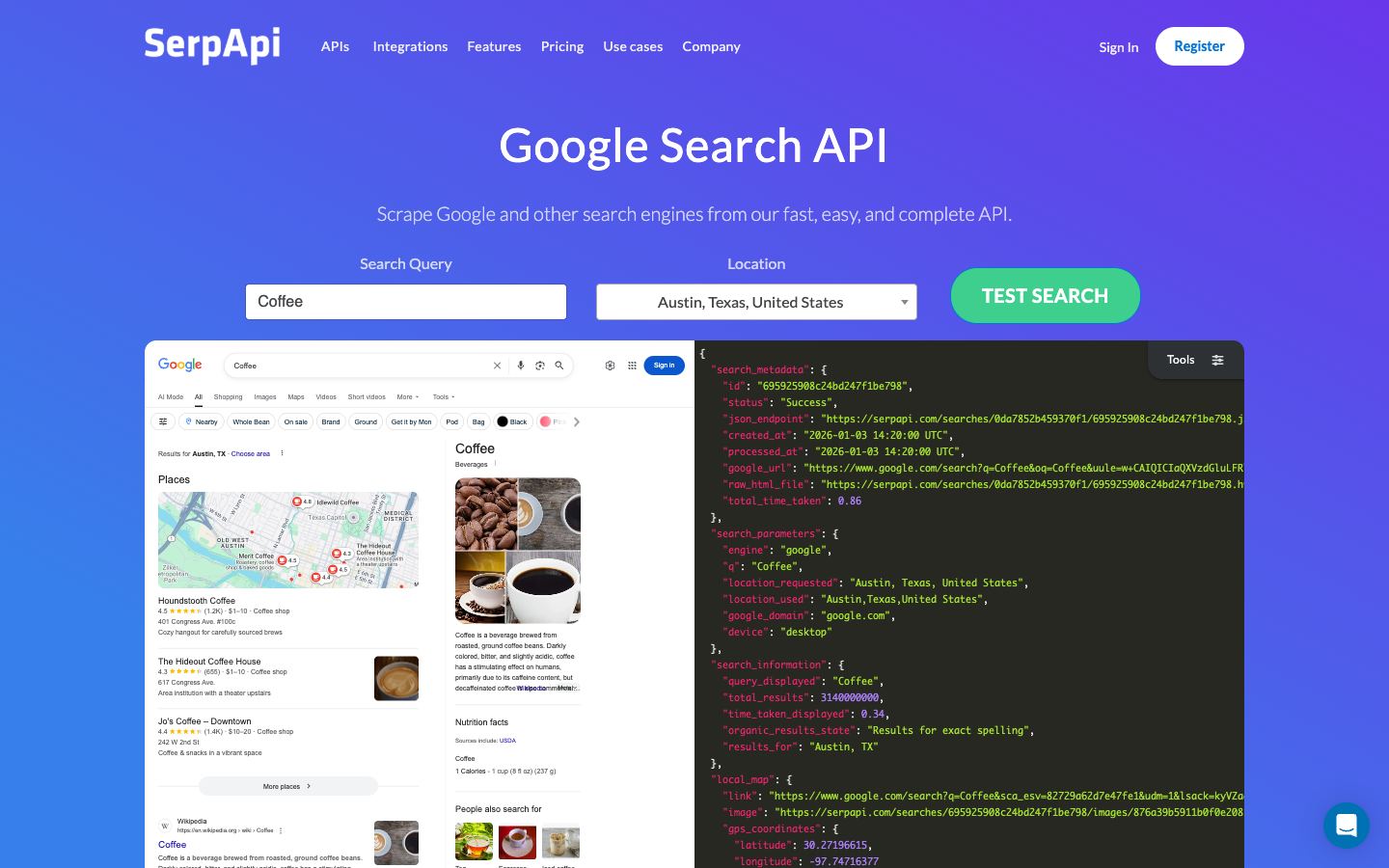
SerpAPI covers more than 80 search engines and result types. That includes Google, Bing, Baidu, Yahoo, Yandex, and DuckDuckGo, plus Google verticals like Shopping, Scholar, News, Jobs, Maps, and YouTube. It handles JavaScript rendering and returns structured JSON for organic results, ads, knowledge panels, featured snippets, local packs, and People Also Ask. That breadth of engine and SERP-element coverage is its main differentiator in the category.
What is the Google lawsuit against SerpAPI?
In December 2025 Google filed a federal DMCA lawsuit alleging SerpAPI circumvented its protections to scrape copyrighted search results at scale, and there is a related Reddit suit. SerpAPI has contested the claims, arguing that the DMCA protects works rather than websites and that accessing public pages is not circumvention. In July 2026 the court granted SerpAPI's motion to dismiss in large part: it permanently threw out the claims covering search results with no copyrighted content and gave Google only a limited window to amend the rest. The related Reddit suit is still open, so some legal uncertainty remains, but SerpAPI prevailed at this first major stage.
What are the best SerpAPI alternatives?
Serper.dev is the alternative people reach for most often, with lower per-query pricing focused on Google. SearchAPI.io and DataForSEO offer similar multi-engine SERP coverage, and ScrapingDog targets budget-conscious users. Tavily and Brave Search API serve AI-native search use cases rather than raw SERP parsing. If you want comparable functionality with potentially lower legal exposure than SerpAPI carries today, Serper.dev or SearchAPI.io are reasonable starting points.
How does SerpAPI compare to Serper.dev?
SerpAPI has the broadest engine and SERP-element coverage, supporting 80-plus engines and many Google verticals, and it has been running since 2017. Serper.dev is narrower and concentrates on fast, low-cost Google search with a few related endpoints. Need Baidu, Yandex, Scholar, or wide vertical coverage? SerpAPI fits better. If you only want cheap Google results at volume, Serper.dev is usually the more economical choice.