Queue-free Google SERP API billed per successful request
Each tool is evaluated against our methodology using public docs, vendor demos, and hands-on testing.
Some links on this page are affiliate links. We earn a commission if you sign up – at no additional cost to you. Our editorial assessment is independent and never paid. How we review.
What is SerpsBot?
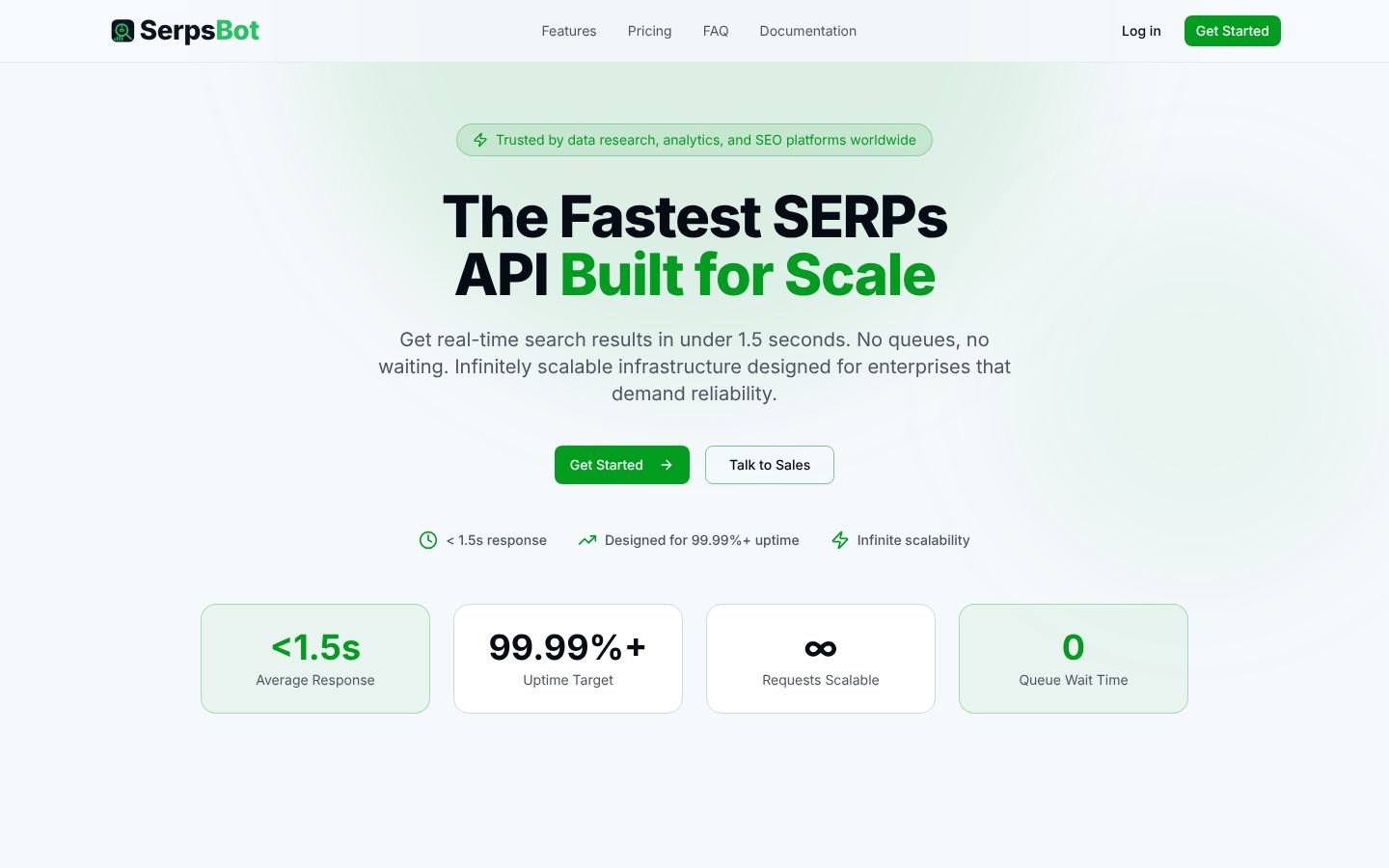
SerpsBot is a Google SERP API from ProAPIs, Inc., a Delaware company. It answers each query on the same request instead of putting it in a job queue, returns results as JSON, and bills per successful request: $2 per 1,000 on pay-as-you-go and $0.80 per 1,000 on its Business subscription.
Our verdict
If your product needs Google result lists and you want to know what each call costs, SerpsBot keeps it simple. You pay a flat rate per request, sign no contract, and subscription credits roll over. The sub-1.5-second response time and 99.99% uptime target are the vendor's own figures. The public docs mostly describe an account endpoint, the site doesn't say which engines are covered, and there's no free tier, disclosed funding or named customer list to lean on. Put a small paid balance on it and test your own queries before you build on it.
Categories:
SERP data APIs provide programmatic access to search engine results pages from Google, Bing, and other engines. They handle the infrastructure complexity of rotating proxies, CAPTCHA solving, and result parsing – delivering clean JSON data. These are the workhorses for SEO monitoring, market research, and any application that needs to understand what search engines are showing users.
Fast Google SERP API priced at a dollar per thousand queries
Freemium·Mar 2026·SERP Data APIs
Low-cost SERP API with batch jobs up to 15,000 requests
Freemium·Mar 2026·SERP Data APIs
Volume-priced SERP API that drops toward 29 cents per thousand
Freemium·Mar 2026·SERP Data APIs
How SerpsBot compares
Serper.devSerper.dev sits at a similar price for Google results, has a free starting allowance, and is already wrapped in LangChain, which shortens integration work.
ScrapingDogScrapingDog also competes on volume pricing and adds a general scraping API for when you need page content as well as result lists.
ValueSERPValueSERP adds batch jobs for scheduled bulk pulls, while SerpsBot is built around answering each call as it arrives.
Frequently asked questions
How much does SerpsBot cost?
SerpsBot publishes three rates. Pay-as-you-go is $0.002 per request ($2 per 1,000) with no minimum. The Launch subscription drops that to $0.0015 per request with a 30 requests-per-second limit, and Business goes to $0.0008 per request ($0.80 per 1,000) at 500 requests per second. More plans sit in the developer portal, and sales quotes custom concurrency. You're billed for successful requests, and unused subscription credits carry into the next month.
Does SerpsBot have a free tier?
No free plan is published. The homepage suggests topping up a small amount to try the API, or emailing sales to ask for a trial. Its terms say prepaid balance never expires, and you can ask for a refund of unused balance within 14 days of a payment. Payments older than 14 days are non-refundable, so keep the first top-up small until you've checked result quality on your own queries.
Which search engines does SerpsBot support?
The website calls it a SERPs API but doesn't list engines. A write-up by the developer describes a Google endpoint that returns results as JSON, with parameters for the query, number of pages, language and country, and support for Google operators such as site:. That makes it usable as a site-search backend. If you need Bing or another engine, confirm coverage with the vendor before planning around it.
How fast is SerpsBot?
The vendor says average responses come back in under 1.5 seconds, sometimes under one second on well-routed regions, and that requests never wait in a queue. Its terms of service are more careful: they aim for under two seconds on standard requests and promise no specific response time. Treat both as vendor claims and time a sample of your own queries, since latency depends on location, query type and page depth.
Who should use SerpsBot?
It fits teams that need Google result lists at steady volume and care mainly about cost per call, such as rank tracking, SEO tooling, or grounding an LLM answer in current results. It returns search results, not the content of the linked pages, so a RAG pipeline still needs a fetch and extraction step. If you'd rather get search plus page content in one call, an AI search API like Tavily is the simpler route.