How much does ValueSERP cost?
ValueSERP uses credit-based monthly plans from Traject Data and is priced as a budget option. Published plans start around $1.60 per 1,000 searches on the entry tier and fall toward $1.00 per 1,000 at the highest published volume. A free trial lets you test queries before you commit to a paid plan. Exact tier pricing changes over time, so check the official pricing page for current credit allotments and per-search rates.
Is ValueSERP open source or self-hostable?
No. ValueSERP is a hosted, proprietary SERP API run by Traject Data. There is no public source code to inspect or modify, and you cannot deploy it on your own infrastructure. You send requests to its endpoint and get results back. If running the scraper yourself is a hard requirement, look at open-source SERP scraping libraries instead.
Does ValueSERP return structured JSON and handle JavaScript-rendered results?
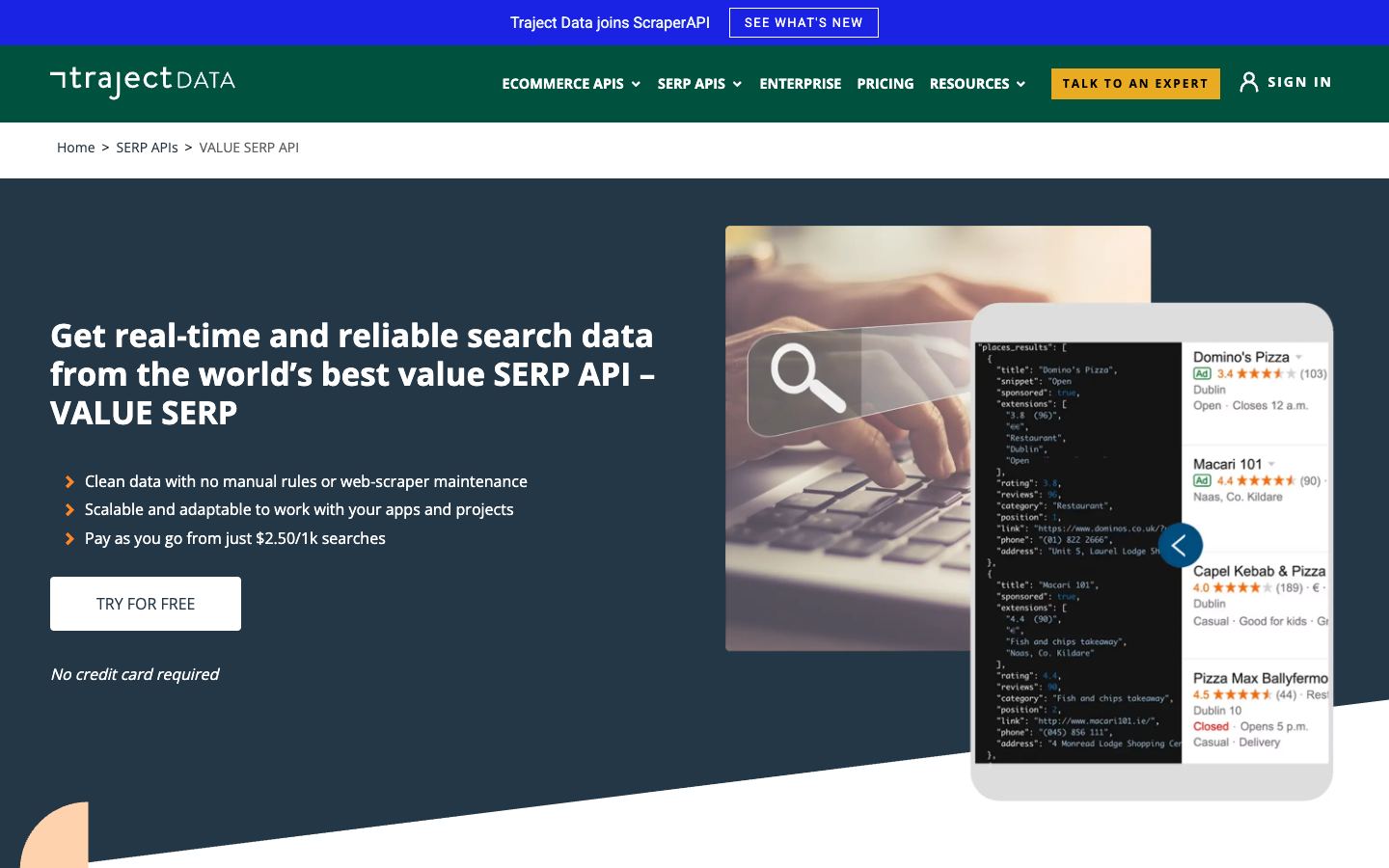
Yes. ValueSERP parses Google search pages and returns structured JSON for organic results, ads, knowledge panels, and related sections, so you do not parse raw HTML yourself. It renders JavaScript on the target pages, which matters for SERP elements that load dynamically. That structured output is the main reason teams use it instead of rolling their own Google scraper.
What is ValueSERP best used for?
ValueSERP fits bulk SERP data collection where cost per query matters more than latency. Its batch feature schedules up to 15,000 requests at once, which suits SEO agencies running periodic rank tracking or large keyword audits. It is less suited to real-time agent workflows that need a single fast lookup, since the batch model and an older API design favor scheduled, high-volume jobs.
What is the best ValueSERP alternative?
Serper.dev is the closest alternative for teams that want low latency and a modern API, and it tends to fit real-time or agent use better than ValueSERP's batch model. DataForSEO is a stronger choice when you need broad coverage across many search engines and data types in one account. ScrapingDog is worth comparing on price for general scraping needs that go beyond SERP data.
How does ValueSERP compare to Serper.dev?
Both return structured Google SERP JSON at low cost, but they target different workflows. ValueSERP centers on batch jobs, scheduling up to 15,000 requests for bulk audits, and is part of the Traject Data family. Serper.dev emphasizes a simpler, faster API better suited to single real-time lookups and agent calls. Pick ValueSERP for scheduled high-volume runs, and pick Serper.dev when per-request speed matters more.