serp.fast

Seltz

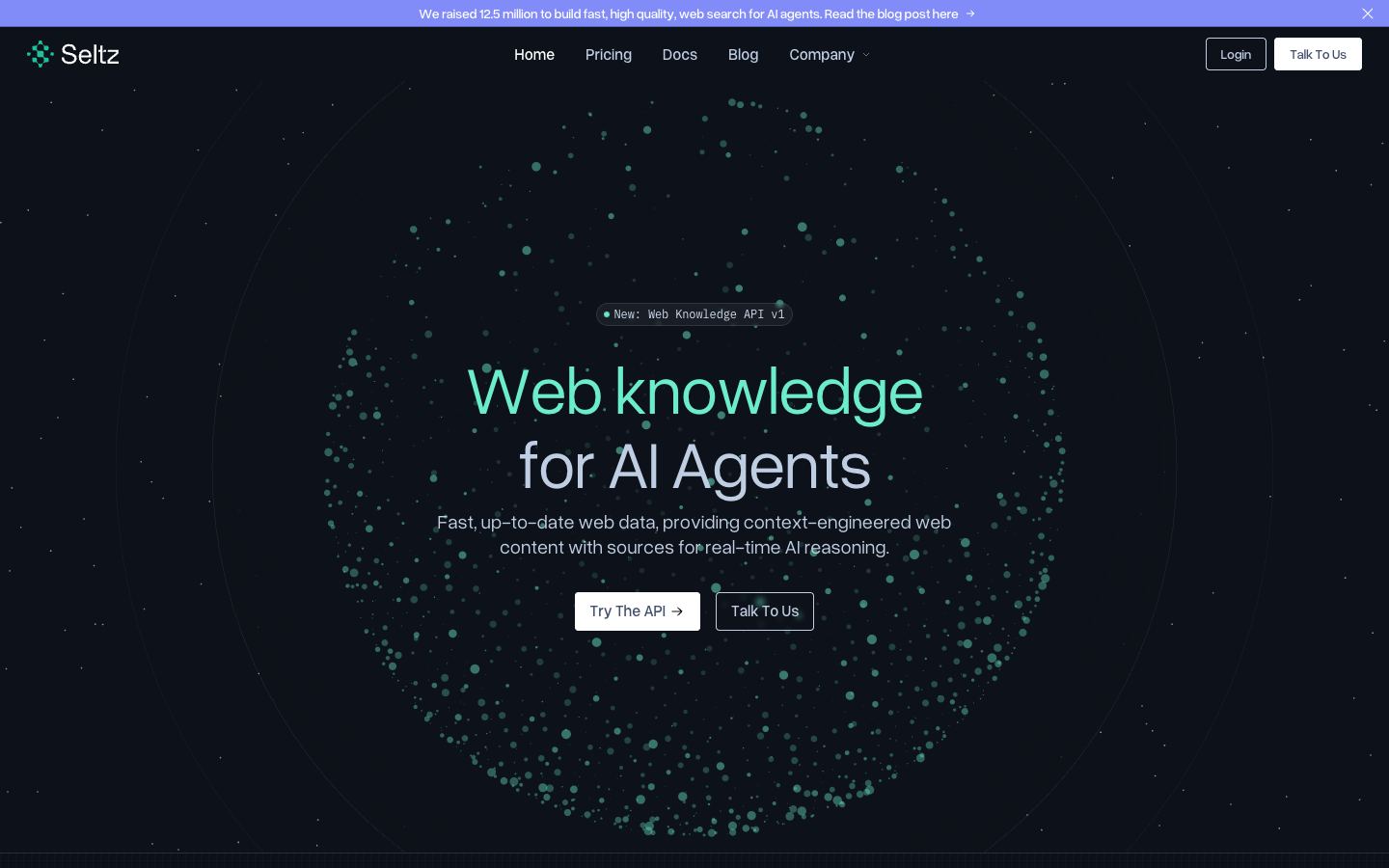
Web Knowledge API for AI agents and RAG that runs its own Rust-built crawler and hybrid lexical, semantic, and graph index rather than wrapping Google or Bing.

Nathan Kessler
By Nathan KesslerUpdated

Each tool is evaluated against our methodology using public docs, vendor demos, and hands-on testing.

AI search APIs are the infrastructure layer that gives large language models access to current web information. Unlike traditional search engines, these APIs return semantically relevant, structured results optimized for retrieval-augmented generation (RAG) and AI agent workflows. They are used by AI products that need to answer questions about the real world beyond their training data.

Some links on this page are affiliate links. We earn a commission if you sign up – at no additional cost to you. Our editorial assessment is independent and never paid. How we review.

Features

JS Rendering
Structured Output
Open Source
Self-Hosted Option
Pricing:FreemiumSee pricing →

Editorial assessment

Most search APIs in this category are thin layers over Google or Bing. Seltz is not: it runs its own crawler, index, and retrieval models, all written in Rust, behind two endpoints. A search call returns ranked documents (url plus content) shaped for LLM context windows, and an answer call returns a markdown response with citations. There is also an OpenAI-compatible chat-completions surface and an MCP server. Founder Antonio Mallia has a real information-retrieval track record (NYU PhD, ex-Pinecone, ex-Amazon, and creator of the open-source PISA search engine), which is the substance behind the owns-the-whole-pipeline pitch. The honest caveat is maturity. Seltz launched its Web Knowledge API publicly in 2026, and current coverage is US-news-first, narrower than the general-web reach of Exa or Tavily; the answer endpoint is explicitly grounded in news search for now. The founder's published latency and accuracy figures are self-reported on Hacker News and have not been independently reproduced, so treat them as vendor claims. Seltz was selected for the AWS and NVIDIA Startup Village at VivaTech 2026 and names institutional investors on its site, but no round size is public, so we do not list one. Worth evaluating if you are building agent loops where latency and full-text, source-cited context matter and you want an index that is not a Google reseller. For broad general-web recall today, the more established peers still have the deeper crawl.

How Seltz compares

Exa

Exa also runs an independent index but retrieves via neural embeddings, where Seltz combines lexical, semantic, and graph signals over its own crawl.

Tavily

Tavily has far broader LLM-framework adoption and general-web coverage today, while Seltz is newer and currently US-news-first.

Linkup

Linkup builds its index from licensed publisher content, whereas Seltz crawls and indexes the web itself in a Rust-built pipeline.

Frequently asked questions

How much does Seltz cost?

Seltz is freemium. The free tier gives you $20 of API credits with no credit card required, and the Pay as You Go tier is $5 per 1,000 requests with no minimum commitment. Enterprise and Bring Your Own Cloud tiers are custom priced. At launch the site also advertised $100 in promotional credits for new users and $1,000 in credits for qualified startups, though promotional credits are time-bound and the standing free tier is the $20 allotment.

Is Seltz open source?

No. The core product (the crawler, index, and retrieval models) is proprietary and hosted only. The github.com/seltz-ai organization has just two small public repositories, both MIT-licensed peripheral tooling. The founder's separate PISA search engine is open source, but that is an academic IR project and not the Seltz product, so you cannot run Seltz's engine yourself.

How does Seltz compare to Exa?

Both run their own independent index rather than reselling Google or Bing. Exa retrieves through neural embeddings and is well suited to semantic discovery and find-similar workloads. Seltz combines lexical, semantic, and graph signals over a Rust-built crawl and positions itself around low-latency, full-text, source-cited context for agent loops. Exa is the more mature product with broader coverage; Seltz is newer and currently US-news-first.

Can I self-host Seltz?

Not in the usual sense. Seltz is a hosted API with key-based authentication, and there is no downloadable server for the free or Pay as You Go tiers. A private, Bring Your Own Cloud deployment is offered only at the Enterprise level under custom pricing, which is a managed private deployment rather than open self-hosting.

What can the Seltz API do?

Seltz exposes two documented capabilities: a search endpoint that returns ranked documents (url plus content) shaped for LLM context windows, and an answer endpoint that returns a markdown answer with citations, currently grounded in news search. It also offers an OpenAI-compatible chat-completions surface, Python and Node/TypeScript SDKs, a REST interface, and an MCP server plus tool-calling integrations. There is no extract, crawl, rank, or JavaScript-rendering endpoint.

Weekly briefing – tool launches, legal shifts, market data.

Visit

Seltz

Visit →