How much does ScrapeOps cost?
ScrapeOps is freemium. The Proxy Aggregator has a free tier that gives you a monthly allowance of API credits with no credit card needed, and paid plans scale up by credit volume from there. Residential and mobile proxies are billed separately by bandwidth. The job monitoring and scheduling tools are free to use. Pricing tiers and credit limits change, so check the current pricing page before you commit to a plan.
Is ScrapeOps open source or self-hostable?
No. ScrapeOps is a hosted SaaS product. It is not open source and you cannot run the proxy aggregator, monitoring dashboard, or scheduler on your own infrastructure. Everything goes through ScrapeOps endpoints and its dashboard. The free Web Scraping Playbook tutorials are openly readable and widely used, but they are documentation, not a licensed codebase you can deploy yourself.
Does ScrapeOps handle JavaScript rendering and anti-bot bypass?
Yes. The Proxy Aggregator routes requests through more than 20 residential, mobile, and datacenter proxy providers from a single endpoint, and premium plans add JavaScript rendering, JavaScript snippet execution, and anti-bot handling. It picks the best-performing provider for each target site. This is its core job: aggregating and managing proxies for scraping at scale, rather than acting only as a search-results parser.
What is ScrapeOps best used for?
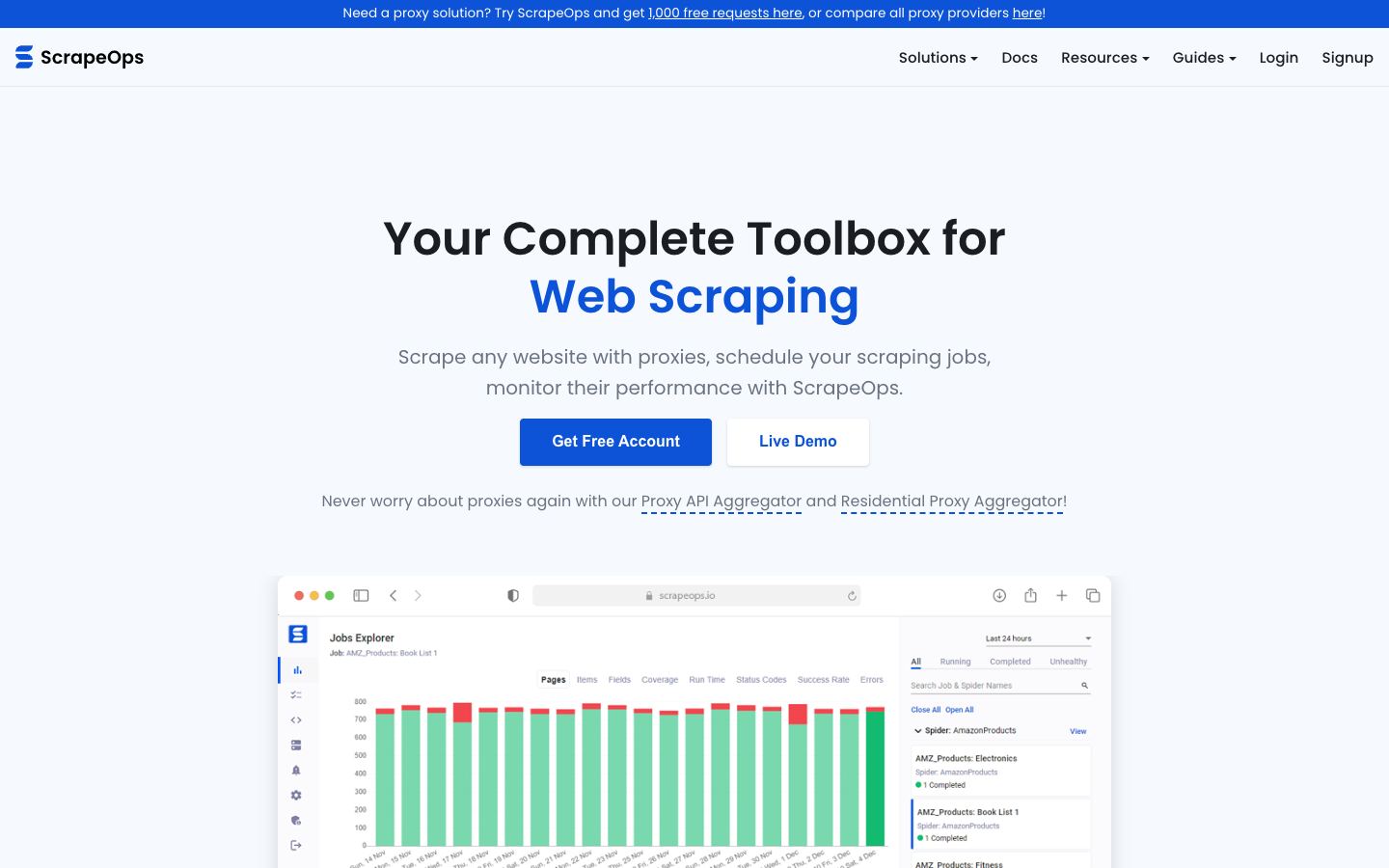
ScrapeOps fits developer teams that already scrape and want to consolidate proxy spend and watch their jobs. The aggregator compares more than 20 providers on real performance data so you route through the best one per site, and the free monitoring and scheduler track success rates and run schedules. It is a developer tool with a strong content engine. Its structured-data APIs (Amazon, Walmart, eBay, Indeed, Redfin) are secondary to the monitoring and proxy aggregation.
What are the best ScrapeOps alternatives, and when should I pick them?
If you need structured search results rather than proxy aggregation, Serper.dev is a low-cost, fast Google SERP API, and SerpAPI covers many search engines with broader parsing. DataForSEO suits teams that want SEO and SERP data at scale under one billing relationship. Pick these when search data is the goal. Pick ScrapeOps when you want managed proxies, multi-provider routing, and scraping job monitoring across arbitrary sites.
How does ScrapeOps compare to SerpAPI?
They solve different problems. SerpAPI is a dedicated search engine results API that returns parsed, structured data from Google and other engines, billed per search. ScrapeOps is mainly a proxy aggregator and scraping monitor that routes traffic through more than 20 providers and handles JavaScript rendering and anti-bot work for any target site. If you only need clean SERP JSON, SerpAPI is more direct. ScrapeOps suits broader scraping where you manage proxies and monitor jobs.