serp.fast

Unblocking scraper API with markdown output and Google plugins

Nathan Kessler
By Nathan KesslerUpdated

Each tool is evaluated against our methodology using public docs, vendor demos, and hands-on testing.

Some links on this page are affiliate links. We earn a commission if you sign up – at no additional cost to you. Our editorial assessment is independent and never paid. How we review.

Scrape.do website

What is Scrape.do?

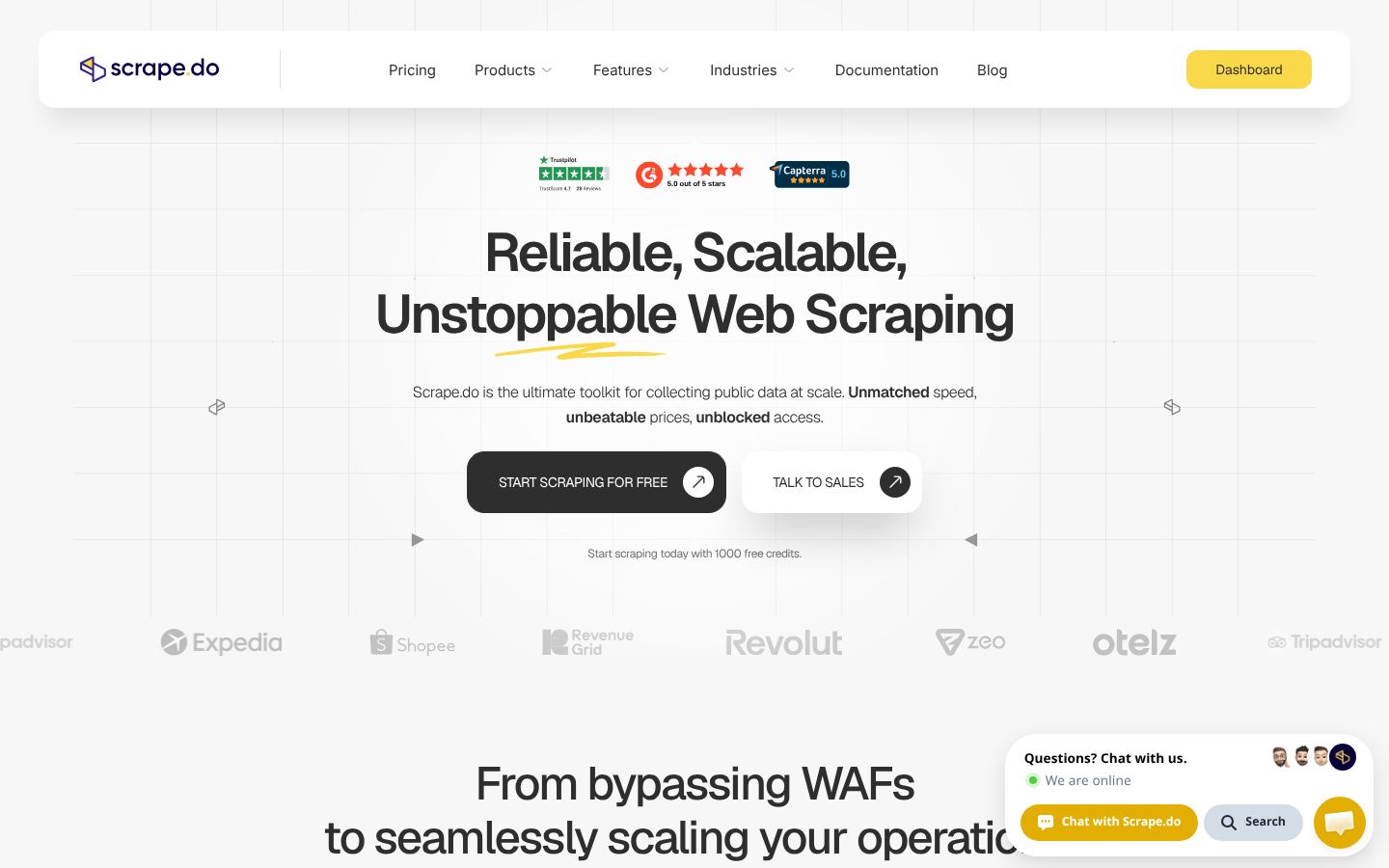
Scrape.do is a hosted scraping API that fetches a URL through rotating datacenter, residential and mobile proxies and can hand the page back as markdown for an LLM prompt. A Google plugin returns parsed SERP JSON, with separate endpoints for AI Overview and AI Mode answers. Credits are used only by successful calls.

Our verdict

When an agent has to read pages it can't load on its own, Scrape.do is an inexpensive unblocking layer to put in front of it. Add output=markdown and the response is ready to drop into a prompt. The Google plugin also returns AI Overview and AI Mode answers, which helps if you track how Google answers questions in your category. Keep in mind that the core API returns pages rather than fields. You still write the step that turns a page into the data your product needs.

Categories:

Web scraping APIs abstract away the hardest parts of web data collection: JavaScript rendering, anti-bot detection, proxy rotation, and data parsing. Instead of building and maintaining your own scraping infrastructure, you send a URL and receive clean, structured data back. For AI applications, many of these APIs now return LLM-ready markdown or structured JSON.

Share:

Turns any website into LLM-ready markdown via a single API

Freemium155K+Web Crawl & Data Extraction APIs

Handles proxy rotation and JS rendering behind one scraping API

FreemiumMar 2026Web Crawl & Data Extraction APIs

Gets scrapers past CAPTCHAs, fingerprinting, and WAF blocks

PaidMar 2026Web Crawl & Data Extraction APIs

How Scrape.do compares

Firecrawl

Firecrawl is built around LLM ingestion, with crawling, site mapping and structured extraction managed for you, which saves work if you don't want to write that layer.

ScraperAPI

ScraperAPI uses the same single-endpoint model of proxies, rendering and retries, so it's the closest like-for-like price comparison.

ZenRows

ZenRows also pairs anti-bot handling with markdown output, and is worth testing side by side on your hardest target sites.

Frequently asked questions

How much does Scrape.do cost?

The free plan gives 1,000 successful credits a month at five concurrent requests, with no card. Paid plans are Hobby at $29 a month for 250,000 credits, Pro at $99 for 1.25 million, Business at $249 for 3.5 million and Advanced at $699, with per-1,000-credit rates falling from $0.11 to $0.06. Every plan has every feature. Specialised endpoints cost more than one credit, so check the credit table for anything beyond a plain fetch.

Can Scrape.do return markdown for an LLM?

Yes. The output parameter takes raw or markdown, and markdown mode strips navigation, ads, headers and footers on the server before the response comes back. Its own n8n and Zapier guides recommend markdown whenever an AI step follows, because it cuts the tokens you send to the model. The documentation is also published as llms.txt, which makes it easier to point a coding agent at the API reference.

Does Scrape.do have a Google search API?

Yes. The /plugin/google/search endpoint returns parsed JSON with organic results, ads, knowledge graph, local listings and other result types. Two more endpoints fetch a deferred AI Overview and Google AI Mode answers with references. A search costs 10 credits, an AI Overview 5 and an AI Mode answer 10. On the Hobby plan, our arithmetic puts a Google search at about $1.10 per 1,000.

How does Scrape.do deal with blocking?

It rotates what it says are more than 150 million datacenter, residential and mobile IPs, with geo-targeting by country or continent. It also runs custom bypasses for WAFs and CAPTCHAs. A managed headless browser handles JavaScript, and the playWithBrowser parameter can click, scroll or run scripts before capture. If a multi-step flow needs one IP throughout, sessionId keeps the same address across requests.

Should I pick Scrape.do or Firecrawl?

They sit at different layers. Firecrawl manages crawling, site mapping and LLM-based extraction, and has an open-source core you can self-host. Scrape.do is a lower-level unblocker priced on credits that hands back HTML or markdown and leaves extraction to you. Pick Scrape.do when hard targets and unit cost matter most. Pick Firecrawl when you'd rather not build crawl and extraction logic yourself.

Visit

Scrape.do

Visit