What is Pline?
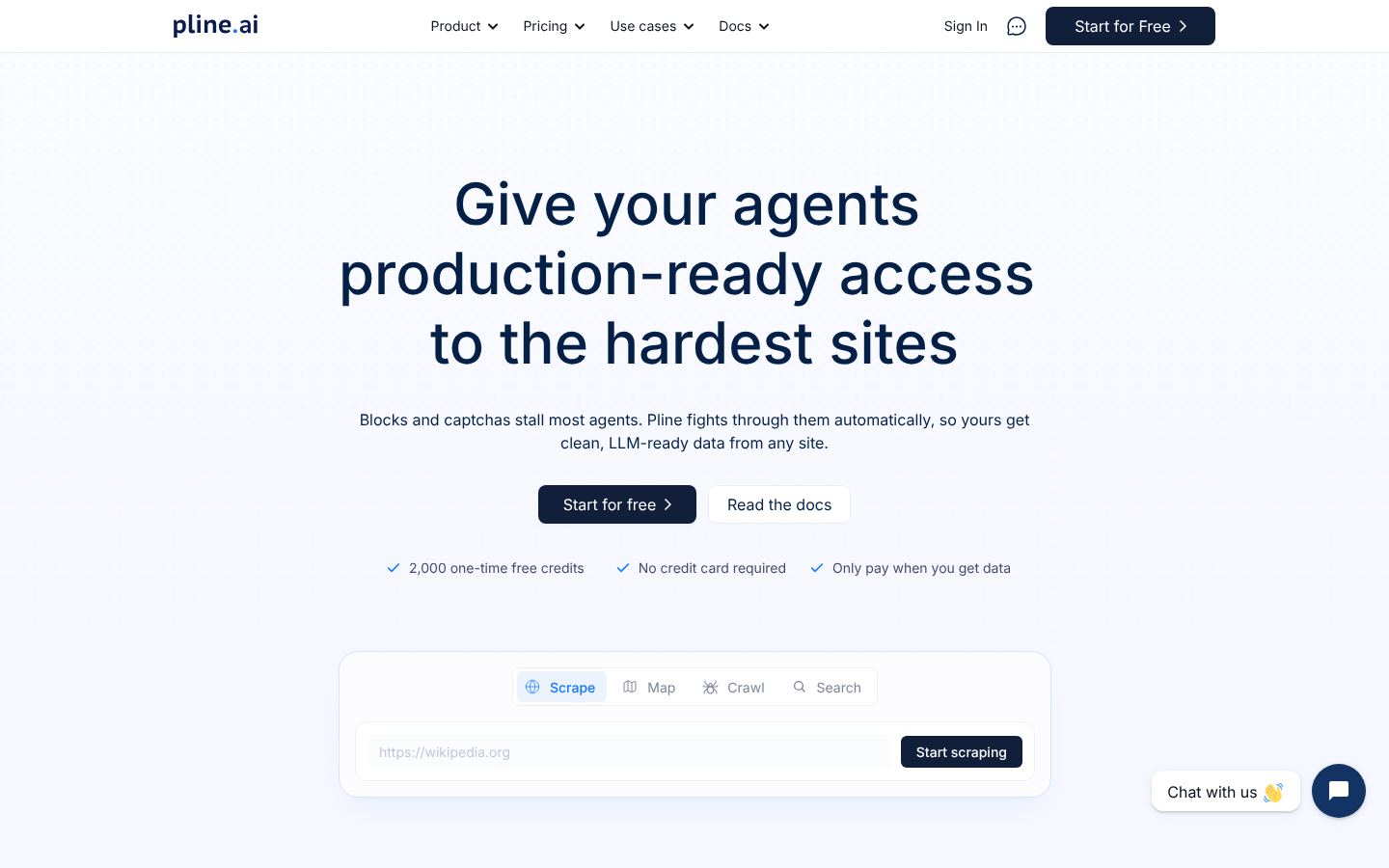
Web data API from Grepsr with scrape, batch scrape, crawl, map, and SERP endpoints that return Markdown or schema-guided JSON, plus an MCP server and agent Skill.
Our verdict
Pline is Grepsr's entry into the Firecrawl-shaped market. Grepsr has sold managed scraping to enterprises since 2012, and Pline started out as its no-code Chrome extension. The developer API is the newer part. It has five jobs: `/scrape` for one URL, `/batch/scrape` for a list, `/crawl` for a whole site, `/map` for URL discovery, and `/serp` for parsed search results. Output can be Markdown, a stripped-down "clean" Markdown with links and images removed, HTML, links, screenshots, or JSON shaped by a prompt and a schema.
For a product team the interesting part is the billing model. By default each request starts on the cheapest fetch and only adds a browser (+2 credits) or a premium proxy (+7) when the page blocks it, and the response tells you which tiers it used. Requests that return no content are free. JSON extraction is the expensive line at +14 credits per page. Plans run from a free tier of 2,000 one-time credits to $700 a month for a million credits, so check the extraction cost against your page mix before you assume you'll get a million pages for $700. Agents connect through `npx pline-api`, which registers an MCP server and installs a Skill.
The homepage claims 99.99% uptime, 3-second average responses, and 95% success on hard sites. Those are vendor numbers with no published method yet. What Grepsr does bring is more than a decade of keeping scrapers running for paying clients. That counts for something, but the API itself is weeks old, so test it on your own targets before you route production traffic through it.
Categories:
Web scraping APIs abstract away the hardest parts of web data collection: JavaScript rendering, anti-bot detection, proxy rotation, and data parsing. Instead of building and maintaining your own scraping infrastructure, you send a URL and receive clean, structured data back. For AI applications, many of these APIs now return LLM-ready markdown or structured JSON.