What is Octen?
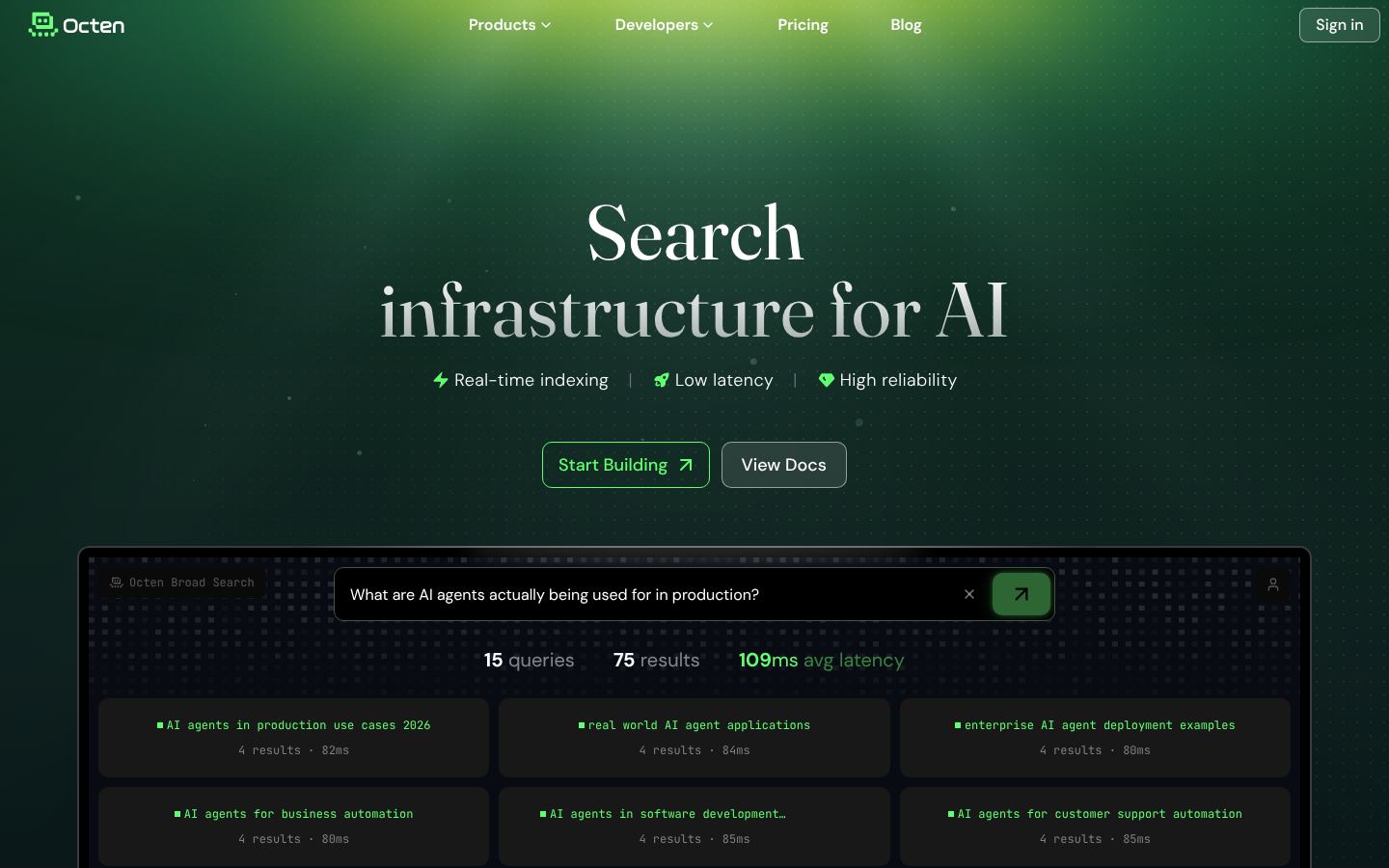
Low-latency web search API for AI agents, with fan-out Broad Search, news and business search, URL extraction and embeddings, ranked on the Artificial Analysis Search Index.
Our verdict
Octen sells search to agents that fire many queries per task, so it competes on speed and price per call. The core is Web Search and Broad Search, which splits one request into up to 30 sub-queries, runs them concurrently and returns results grouped by sub-query. Around that sit News and Business search, image search, an Extract endpoint for up to 20 URLs per call, embedding models, and paid answer and deep-research applications. It ships a Python SDK, a CLI and a hosted MCP server. Founder and CEO Kuan Zou launched the search API in March 2026, the same month DealStreetAsia reported a $10M seed round led by Square Peg.
The most useful evidence comes from outside Octen. The Artificial Analysis Search Index runs every provider through the same agent and model, and it scores Octen Search (highlights) at 77, against 80 for the top Exa configuration. Octen is the fastest provider on that board, at 14.5 seconds per task and 0.21 seconds per search query, and it cost $9.07 in search fees per 1,000 tasks. Octen's own figures, such as a 62ms p50 search latency and its SimpleQA scores, are vendor claims measured another way.
The official pricing page lists Web Search and Broad Search at $1 per 1,000 calls or sub-queries, marked as 80% off a $5 list price. Extract is $1 per 1,000 successful URLs, or $2.50 in advanced mode, and new accounts get $5 of free balance. Reserved-throughput plans start at $2,099 a month for 50 QPS. Because the search rate is labelled as a discount, budget against the list price too. The company is young, but if search latency dominates your agent loop, Octen belongs on the shortlist.
Categories:
AI search APIs are the infrastructure layer that gives large language models access to current web information. Unlike traditional search engines, these APIs return semantically relevant, structured results optimized for retrieval-augmented generation (RAG) and AI agent workflows. They are used by AI products that need to answer questions about the real world beyond their training data.