Is Lightpanda open source?
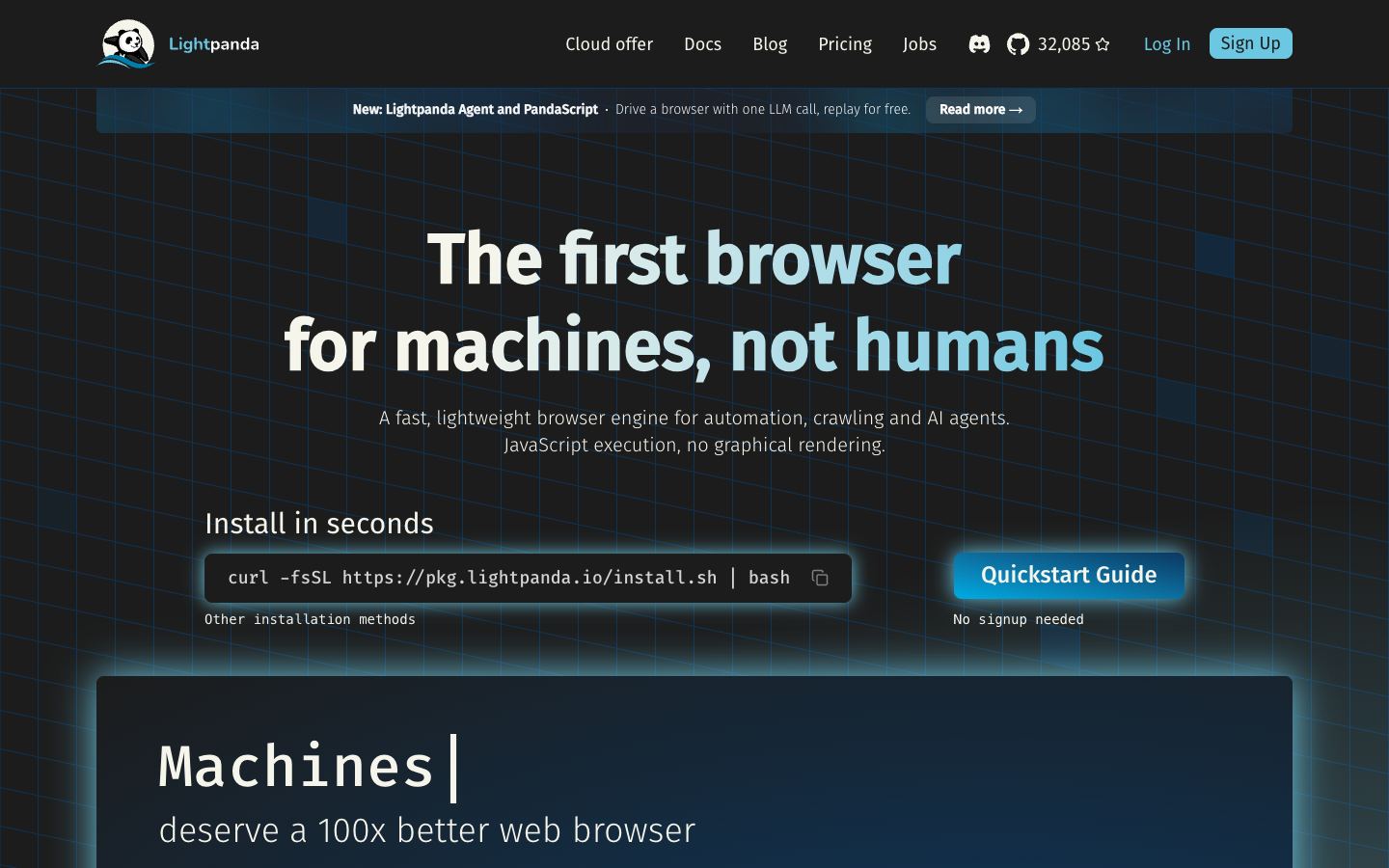
Yes. Lightpanda is an open-source headless browser built from scratch in Zig rather than forked from Chromium. The project is developed in the open on GitHub with more than 30,000 stars. You can install and run the engine yourself for free under its open-source license. The company also operates a separate hosted cloud service, but the core browser engine itself is freely available source.
How much does Lightpanda cost?
The open-source engine is free to download, run, and self-host with no usage charges. Lightpanda also runs a managed cloud service for teams that prefer a hosted endpoint instead of operating their own infrastructure. Lightpanda Cloud now publishes tiered pricing: a free Explorer plan with 10 browser hours a month, a $19 per month Builder plan that includes 300 hours and then bills $0.08 per extra hour, and custom Enterprise pricing. For most evaluation, the free self-hosted build is the place to start.
Can Lightpanda be self-hosted?
Yes. Because the engine is open source, you can install it on your own machines or servers and run it without depending on Lightpanda's cloud. A common pattern is connecting existing Playwright or Puppeteer scripts to a local Lightpanda instance over the CDP protocol. Self-hosting gives you control over scaling and data, which matters for high-volume crawling where per-request cloud costs add up.
Does Lightpanda render JavaScript like Chrome?
Lightpanda executes JavaScript and exposes the DOM, which is what lets automation and AI agents drive pages. It is not a pixel-for-pixel Chrome renderer, and the project is still in beta, so JavaScript compatibility and rendering fidelity lag Chromium on complex sites. Part of the speed and memory savings comes from skipping full visual rendering. Test it against your actual target pages before relying on it in production.
What is Lightpanda best used for?
Lightpanda targets high-volume crawling and AI-agent workloads where running thousands of headless Chrome instances is expensive on memory and CPU. The project reports 11x faster performance and 9x less memory than Chrome, which is the main reason to adopt it. For straightforward content extraction at scale it can cut infrastructure cost. For heavy single-page apps or sites with strict anti-bot checks, Chromium-based tools remain the safer choice today.
How does Lightpanda compare to Browserless?
Browserless is a managed Chromium-based browser service that prioritizes rendering fidelity and compatibility, since it runs real Chrome. Lightpanda is a lighter, custom engine optimized for cost and throughput rather than exact parity. Choose Browserless when you need pages to behave exactly as in Chrome or you face strong bot detection. Choose Lightpanda when crawl volume and infrastructure cost dominate and you can tolerate its current beta compatibility gaps. Steel.dev and Browserbase occupy similar managed-browser territory.