How much does Hyperbrowser cost?
Hyperbrowser is freemium. You can start on a free tier and move to usage-based pricing as you scale. Billing tracks how much you actually run rather than fixed monthly seats, which suits variable agent workloads but makes cost forecasting harder, since spend follows session time and page volume. Check the current rates on its pricing page before you commit to a budget, because usage-based plans can shift as your traffic grows.
Is Hyperbrowser open source?
No. The hosted Hyperbrowser platform is not open source. You consume it as a managed browser-as-a-service through an API, and you cannot read or fork the infrastructure code. The company does publish HyperAgent, its automation layer, as a separate open project, so that piece is open even though the cloud browser fleet you run sessions on stays proprietary and closed.
Can I self-host Hyperbrowser?
No. Hyperbrowser does not offer a self-hosted or on-premise option. It runs as a managed cloud service, and you connect to its browser fleet over the API instead of running browsers in your own infrastructure. If keeping browsers inside your own VPC is a hard requirement for data residency or compliance, Hyperbrowser will not meet it, and you should look at tools that ship a self-hostable runtime.
What does Hyperbrowser do?
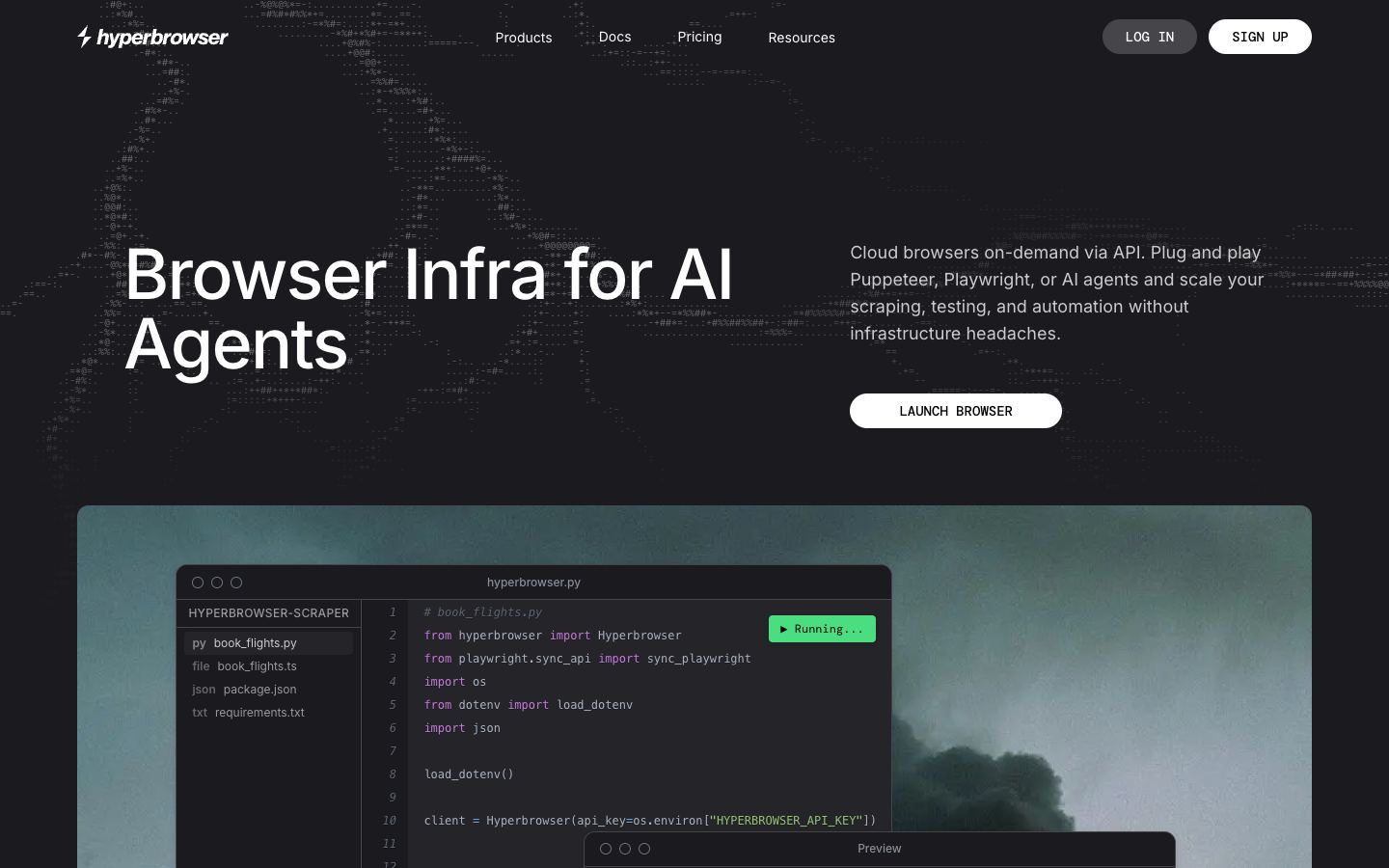
Hyperbrowser is browser-as-a-service aimed at AI agents. It runs full JavaScript-rendering Chromium sessions in the cloud, with launch times the company cites as sub-second and support for thousands of concurrent sessions. It works with standard automation libraries and adds HyperAgent, a layer that takes natural-language instructions and can return structured output. It is YC-backed, with funding from Accel and SV Angel.
How does Hyperbrowser compare to Browserbase?
Both are managed cloud browser platforms for AI agents, with JavaScript rendering and high concurrency. Browserbase has been in market longer and is generally seen as the more proven enterprise option. Hyperbrowser leans on its HyperAgent natural-language layer and fast launch times as the difference. The trade-off is that natural-language automation is convenient but adds latency and variability compared with the deterministic scripts Browserbase is often used for.
When should I choose Hyperbrowser over its alternatives?
Pick Hyperbrowser if you want a managed browser backend for AI agents and value the HyperAgent natural-language layer plus fast session startup. Choose Browserbase if enterprise track record matters most, Airtop if you want a higher-level no-code agent flow, or Steel.dev if open-source leanings and a self-hostable path are priorities. Hyperbrowser fits teams comfortable with a proprietary, usage-billed service that accept some unpredictability from natural-language automation.