What is DeepSeek Search API?
Standalone web search and page-fetch endpoints from DeepSeek, backed by its in-house search engine and billed at $0.75 per 1,000 successful requests.
Our verdict
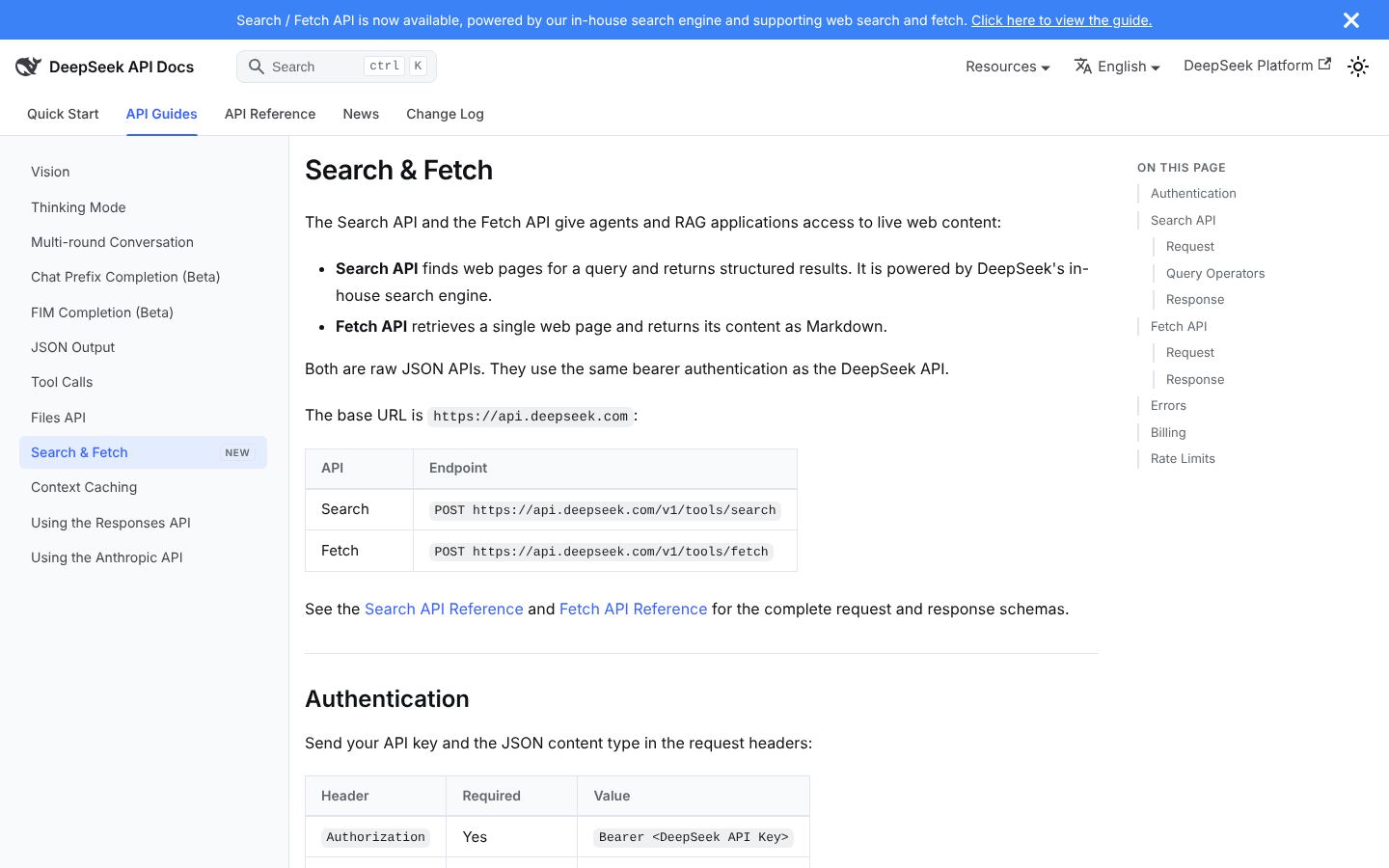
DeepSeek opened its Search and Fetch APIs to all API users on October 17, 2026, in the same announcement as its V4.1-Flash-1017 model. Search (POST /v1/tools/search) queries DeepSeek's in-house engine and returns 1 to 50 results, each with a title, URL, snippet, date, a longer summary meant for a model to read, an authority tier and a rerank score. Fetch (POST /v1/tools/fetch) returns one page as Markdown. Both are plain JSON endpoints on your existing DeepSeek API key, so you can hand the results to any model.
Price is the main reason to look at it. Each endpoint costs $0.75 per 1,000 successful requests, and failed calls, empty results and timeouts are not billed. Artificial Analysis lists Exa at $7, Tavily at $8 and Brave and Perplexity at $5 per 1,000 queries at list price. Serper is the closer comparison: $1.00 per 1,000 on its entry pack, falling to $0.30 on its largest. The documented account limits are 100 requests per second for Search and 25 for Fetch, which is enough for most agent products.
Quality has one independent data point so far. On the Artificial Analysis Search Index (data as of October 19, 2026), DeepSeek Search scores 69, against 80 for the leaders and 33 for the same model with no search. That puts it in the lower half of the 27 configurations AA tests, though its search spend per task is among the lowest. DeepSeek says the engine serves hundreds of millions of requests a day; that is its own claim. Test it on your own queries, especially non-Chinese ones, before you move traffic.
Categories:
AI search APIs are the infrastructure layer that gives large language models access to current web information. Unlike traditional search engines, these APIs return semantically relevant, structured results optimized for retrieval-augmented generation (RAG) and AI agent workflows. They are used by AI products that need to answer questions about the real world beyond their training data.