Is Colly free to use?
Yes. Colly is an open-source Go library released under the Apache 2.0 license, with no paid tier or usage caps. You install it as a Go package and run it on your own machine or servers. Your only costs are the infrastructure you run it on plus any proxies or external services you choose to add for handling blocks or scaling up.
Is Colly open source?
Yes. Colly is open source under the Apache 2.0 license and developed in the open on GitHub, where it has gathered more than 20,000 stars. You can read the source, fork it, and modify it freely, including in commercial projects. Because it is a Go package rather than a hosted service, there is no vendor account or API key to manage.
Can Colly render JavaScript?
No. Colly fetches and parses raw HTML over HTTP and has no built-in browser engine, so pages that build their content client-side with JavaScript can return empty or partial data. The usual workaround is to render the page first with a headless browser such as ChromeDP, then pass the resulting HTML to Colly for parsing. For static, server-rendered pages this is not a concern.
Is Colly self-hostable?
Yes, and self-hosting is the only model. Colly is a library you compile into your own Go program, so it runs entirely on infrastructure you control with no hosted backend involved. That keeps data in your environment and avoids per-request fees, at the cost of operating the crawler, proxies, and storage yourself. There is no managed Colly cloud to fall back on.
What is Colly best used for?
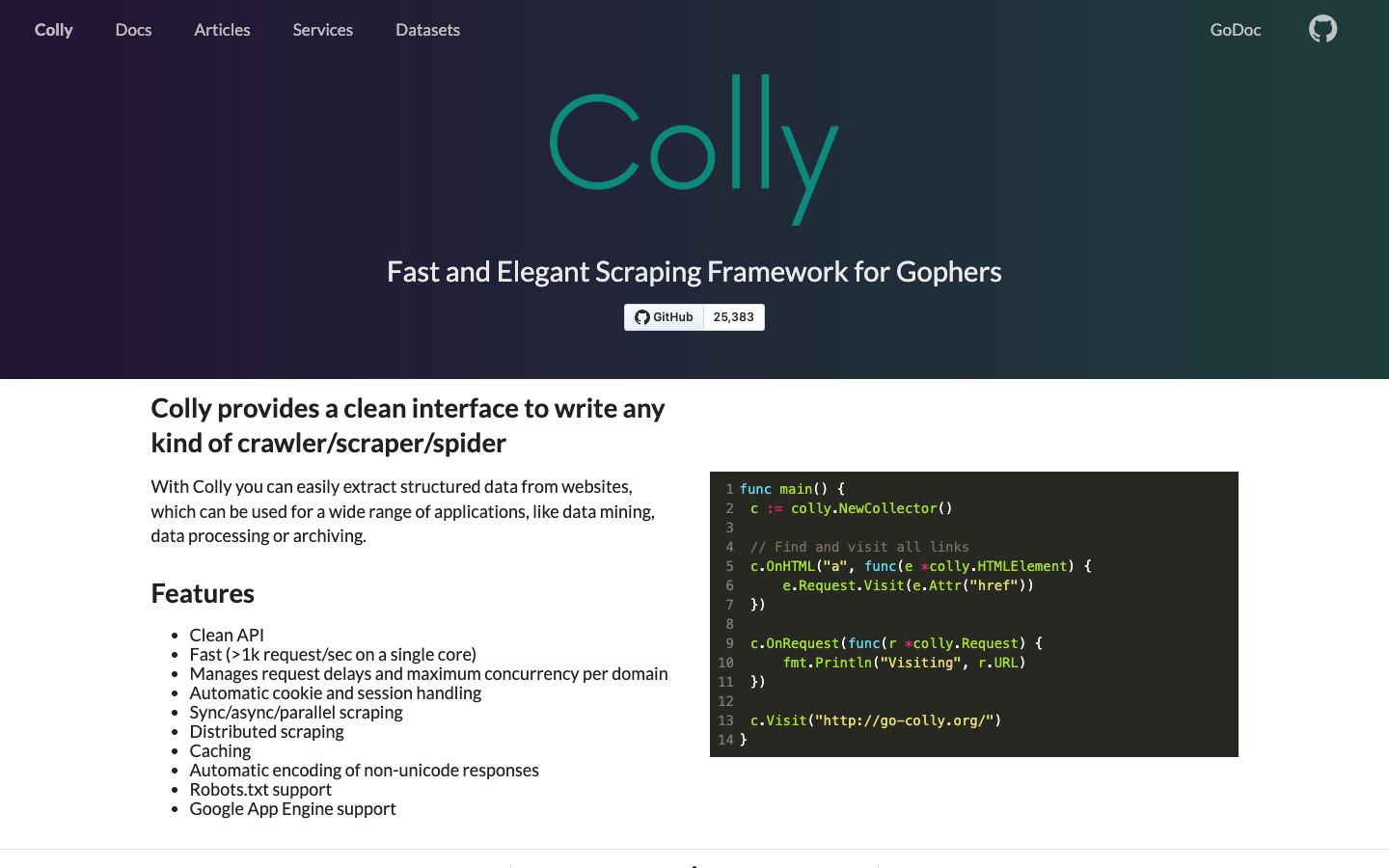
Colly fits high-volume crawling of static or server-rendered pages where you want Go's concurrency and a single compiled binary. Its callback-based API and goroutine-driven requests handle large link graphs efficiently. It is a weaker fit for JavaScript-heavy single-page apps, and its ecosystem of examples and plugins is smaller than what Python tools offer.
How does Colly compare to Scrapy?
Both are open-source scraping frameworks, but Colly is written in Go and Scrapy in Python. Colly compiles to a single binary and uses goroutines for concurrency, which suits teams already working in Go. Scrapy has a larger community, more middleware and tutorials, and built-in features like item pipelines and an interactive shell. Neither renders JavaScript on its own. Pick Scrapy for ecosystem depth, Colly for Go's performance and deployment model.