serp.fast

Ceramic

Web-search API for AI agents and LLMs that runs its own index and a single /search endpoint rather than reselling Google or Bing, from ex-Google search architect Anna Patterson.

Nathan Kessler
By Nathan KesslerUpdated

Each tool is evaluated against our methodology using public docs, vendor demos, and hands-on testing.

AI search APIs are the infrastructure layer that gives large language models access to current web information. Unlike traditional search engines, these APIs return semantically relevant, structured results optimized for retrieval-augmented generation (RAG) and AI agent workflows. They are used by AI products that need to answer questions about the real world beyond their training data.

Some links on this page are affiliate links. We earn a commission if you sign up – at no additional cost to you. Our editorial assessment is independent and never paid. How we review.

Features

JS Rendering
Structured Output
Open Source
Self-Hosted Option
Pricing:FreemiumSee pricing →

Editorial assessment

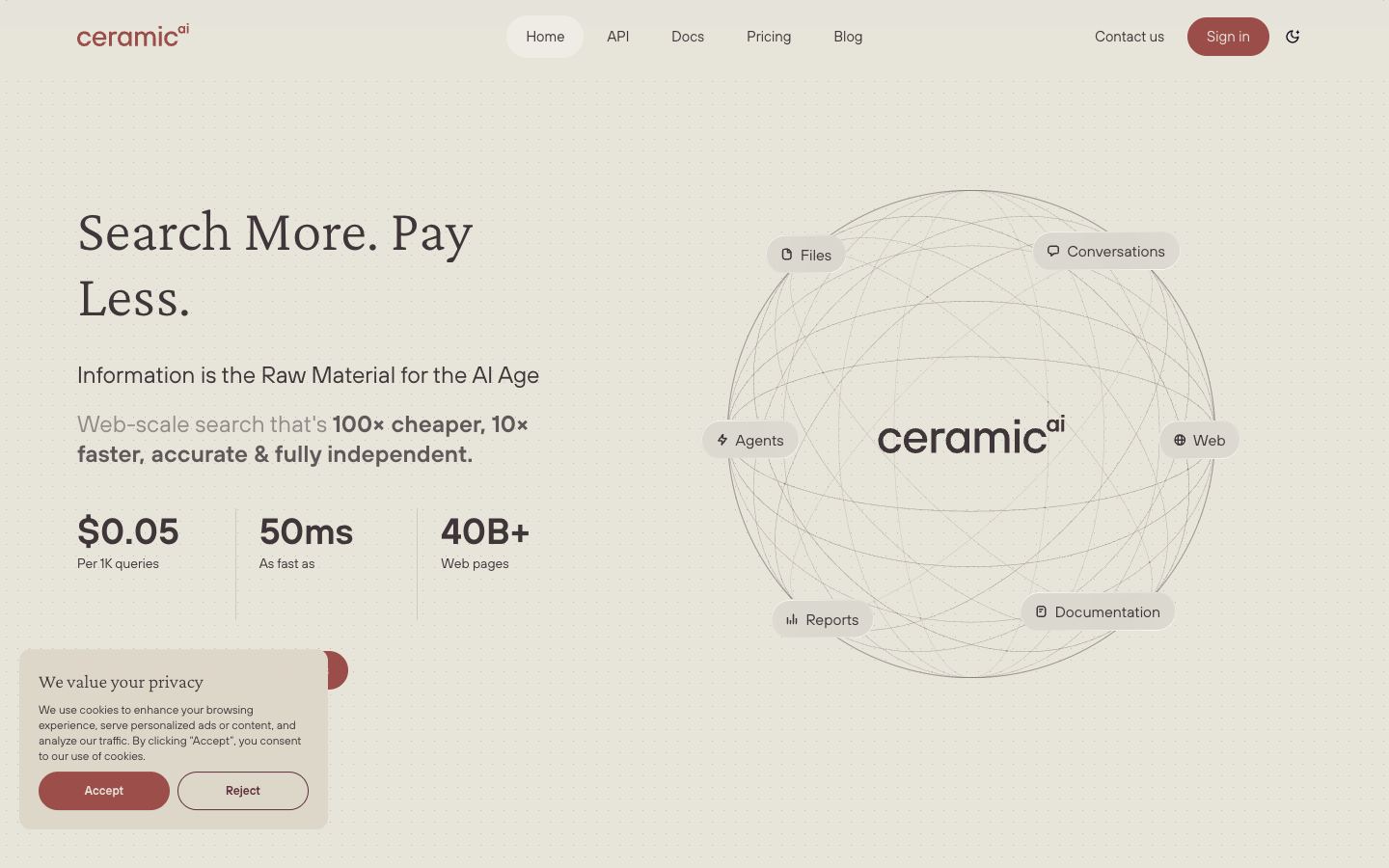
Ceramic.ai is a web-search API built for LLMs and agents, founded by Anna Patterson, who was a VP of Engineering at Google, architected its TeraGoogle index, and later founded Gradient Ventures. Co-founder and chief scientist Tom Costello previously built the search engine Cuil. That search pedigree is the substance behind the pitch. The generally available product is a single /search endpoint at api.ceramic.ai that returns JSON results (title, url, and a text-snippet description, with snippet length tunable) shaped for machine consumption rather than human browsing. It ships Python and TypeScript SDKs, an MCP server, and integrations for LangChain, LlamaIndex, CrewAI, and Anthropic tool use, and is positioned as retrieving from its own index rather than wrapping Google or Bing. The company is the same one that launched out of stealth in March 2025 as LLM training infrastructure, raising a $12M seed led by NEA with IBM, Samsung Next, Earthshot Ventures, and Alumni Ventures; it has since led with the search API. At NVIDIA GTC 2026 it announced Supervised Generation, a verification and citation layer powered by NVIDIA Nemotron 3 Nano, but that is waitlist-only and there is no generally available answer endpoint today, so /search returning snippets is the surface you can actually build on. Headline claims (100x cheaper, roughly 50ms latency, a 40B+ page index) are vendor-reported and we have not seen them independently benchmarked. Worth evaluating if you want a low-cost, index-independent search API for agent loops and are comfortable with a young product whose search-specific track record and customer base are not yet public. For deeper retrieval with full page contents, or broader proven coverage, the more established peers are the safer default. Note the name collision: this is ceramic.ai, not the unrelated web3 Ceramic Network at ceramic.network.

How Ceramic compares

Exa

Exa also runs an independent index and retrieves via neural embeddings with full page-content fetch, where Ceramic's GA endpoint returns title, url, and snippet only.

Seltz

Seltz likewise runs its own crawler and index rather than reselling Google or Bing, but is currently US-news-first, while Ceramic positions as general web-scale search.

Tavily

Tavily has far broader LLM-framework adoption and a proven track record today, while Ceramic is a newer search product with no public customer list.

Frequently asked questions

How much does Ceramic.ai cost?

Ceramic.ai is freemium. New accounts get 1,000 free credits, and paid usage is $0.05 per 1,000 queries. The Pay As You Go tier has no monthly commitment and allows up to 20 QPS; the Pro tier adds $99 per month for up to 50 QPS and priority support. An Enterprise tier is custom-priced with QPS reservations, zero data retention, an SLA, and dedicated infrastructure. The free credits are a one-time starter allowance, not a permanent free plan.

Is Ceramic.ai open source?

No. The search product is proprietary and hosted only at api.ceramic.ai. It publishes Python (ceramic_ai) and TypeScript (ceramic-ai) SDKs, but no open-source repository for the search engine was found. Note that the github.com/ceramicstudio/ceramic-ai repository belongs to the unrelated web3 Ceramic Network, not to this company, so do not treat those repos as Ceramic.ai's source.

How does Ceramic.ai compare to Exa?

Both run an index positioned as independent of Google and Bing. Exa retrieves through neural embeddings, offers a find-similar primitive, and can return full page contents, which makes it strong for semantic discovery and research agents. Ceramic.ai's generally available endpoint returns title, url, and a text snippet per result and is pitched on low price and latency for high-volume agent search. Exa is the more mature product with a public track record; Ceramic is newer.

Is Ceramic.ai the same as Ceramic Network?

No. This entry is ceramic.ai, the web-search API founded by Anna Patterson. It is a different entity from Ceramic Network (ceramic.network), the web3 decentralized-data protocol behind ComposeDB. The two share a name but are unrelated. Ceramic.ai also began life in 2025 as LLM training infrastructure and is the same company that has since expanded into the search API.

What can the Ceramic.ai API do?

The generally available capability is a single /search endpoint at api.ceramic.ai that returns JSON results with title, url, and a snippet description per result, plus search metadata. It supports cURL, Python and TypeScript SDKs, an MCP server, and integrations for LangChain, LlamaIndex, CrewAI, and Anthropic tool use. A Supervised Generation verification and citation layer was announced at NVIDIA GTC 2026 but is waitlist-only, so there is no generally available answer endpoint yet. There is no documented full-page extract, crawl, or JavaScript-rendering endpoint.

Weekly briefing – tool launches, legal shifts, market data.

Visit

Ceramic

Visit →