serp.fast

Scraper, Google SERP and Amazon APIs sold as separate plans

Nathan Kessler
By Nathan KesslerUpdated

Each tool is evaluated against our methodology using public docs, vendor demos, and hands-on testing.

Some links on this page are affiliate links. We earn a commission if you sign up – at no additional cost to you. Our editorial assessment is independent and never paid. How we review.

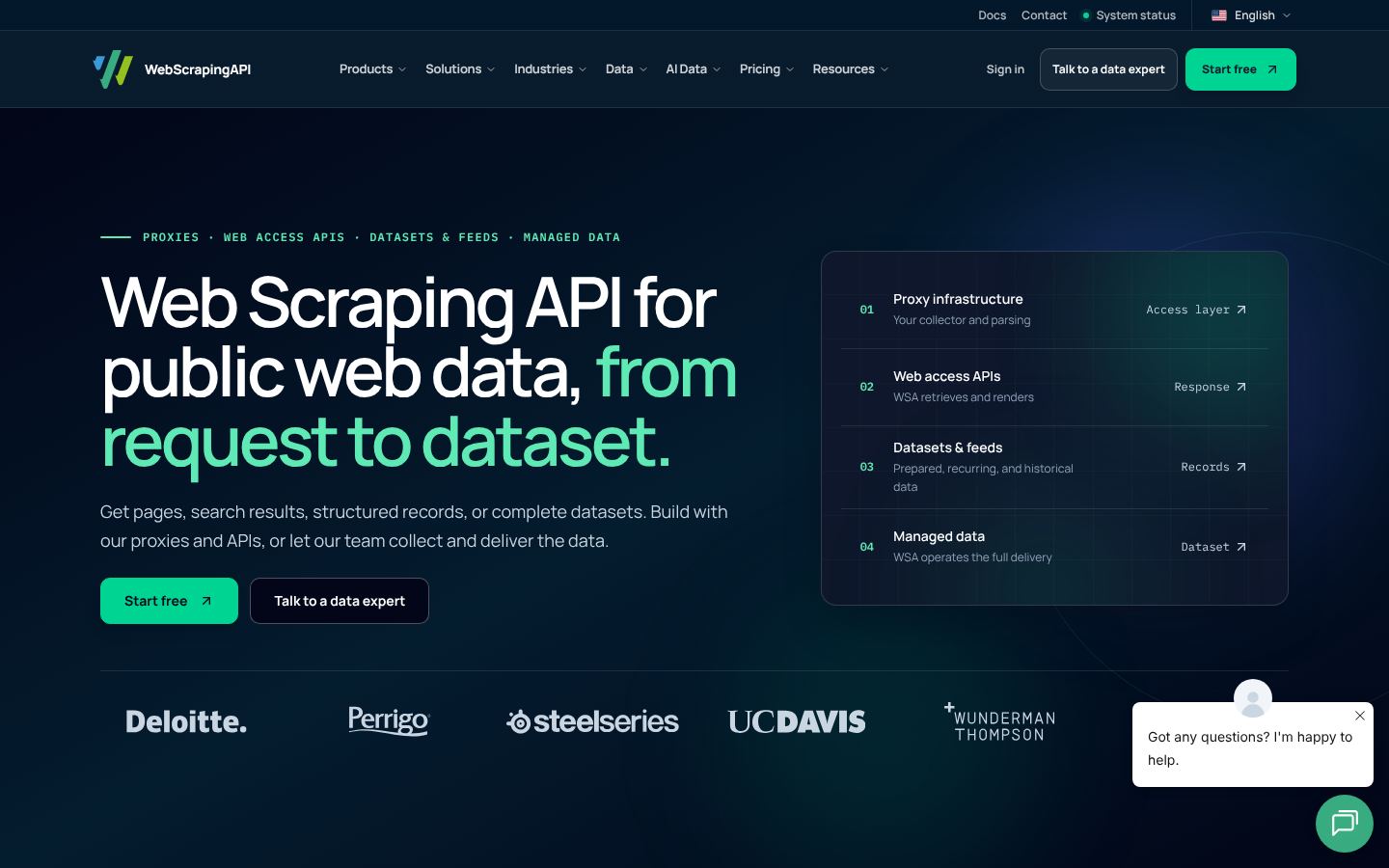
WebScrapingAPI website

What is WebScrapingAPI?

WebScrapingAPI sells several separately priced products: a Scraper API that returns rendered pages, a Google SERP API, an Amazon Data API, residential proxies and a managed data service. The self-serve APIs each come with a free trial. Paid plans start at $19 a month for the Scraper API and $28 a month for Google search.

Our verdict

The catalogue is wide, but for an AI product team it works more like a menu of per-source APIs than one general tool. That suits an agent with a fixed set of sources, say Google results and Amazon listings, where you'd rather pay per source than run a general crawler. We didn't find markdown output or an MCP server among its published features, which newer competitors now treat as standard. The company is privately held with no disclosed funding, so there's little outside information on it to check.

Categories:

Web scraping APIs abstract away the hardest parts of web data collection: JavaScript rendering, anti-bot detection, proxy rotation, and data parsing. Instead of building and maintaining your own scraping infrastructure, you send a URL and receive clean, structured data back. For AI applications, many of these APIs now return LLM-ready markdown or structured JSON.

Share:

Volume-priced SERP API that drops toward 29 cents per thousand

FreemiumMar 2026SERP Data APIs

Turns any website into LLM-ready markdown via a single API

Freemium155K+Web Crawl & Data Extraction APIs

Handles proxy rotation and JS rendering behind one scraping API

FreemiumMar 2026Web Crawl & Data Extraction APIs

How WebScrapingAPI compares

ScraperAPI

ScraperAPI covers the same single-endpoint scraping job with structured endpoints for Google and Amazon, and is the most direct price comparison.

Firecrawl

Firecrawl is the pick if your agent needs clean markdown from arbitrary pages rather than parsed data from a few known sources.

Frequently asked questions

How much does WebScrapingAPI cost?

Each product is priced on its own. The Scraper API starts free with 5,000 requests, then from $19 a month. The SERP API gives 100 free Google searches, then from $28 a month. The Amazon Data API offers 100 free requests and starts at $59 a month. Residential proxies are $8.50 per GB pay-as-you-go or from $52 a month, and managed data programs start at $299 a month. The Browser API and Crawl API are quoted per workload.

Does WebScrapingAPI have a Google SERP API?

Yes, as a separate product with its own Google plans, starting with 100 free searches and then from $28 a month. It returns parsed results so you don't have to maintain HTML selectors for Google's layout. Because it's priced apart from the Scraper API, a team that needs both search results and page content will be paying for two subscriptions, which is worth costing out against single-credit-pool vendors.

Which languages does WebScrapingAPI support?

It's a REST API, so any HTTP client works. The vendor publishes code examples for Python, PHP, Java, Ruby, Node.js, R, C#, Elixir, Rust and Go, which is wider than most competitors list. Responses come back as JSON, CSV or raw HTML depending on the product and parameters, and the vendor handles proxy rotation, JavaScript rendering and CAPTCHA solving on its side.

Is WebScrapingAPI a good fit for AI agents?

It works as a fetch layer, but you'll do more of the LLM preparation yourself. The Scraper API returns HTML or JSON, so you'll need your own cleanup or extraction step before the content goes to a model. Where it helps is the parsed Google and Amazon endpoints, which skip that step for those two sources. For arbitrary pages fed straight into prompts, a markdown-first tool such as Firecrawl needs less glue code.

Is WebScrapingAPI a proxy provider?

It sells residential proxies and stealth proxies, but its main self-serve products are scraping APIs that handle proxies internally, so it's listed here as a data extraction API. That distinction matters for buying. If you only want IPs to plug into your own scrapers, the proxy plans are the relevant product, and if you want results without managing infrastructure, start with the Scraper or SERP API.

Visit

WebScrapingAPI

Visit