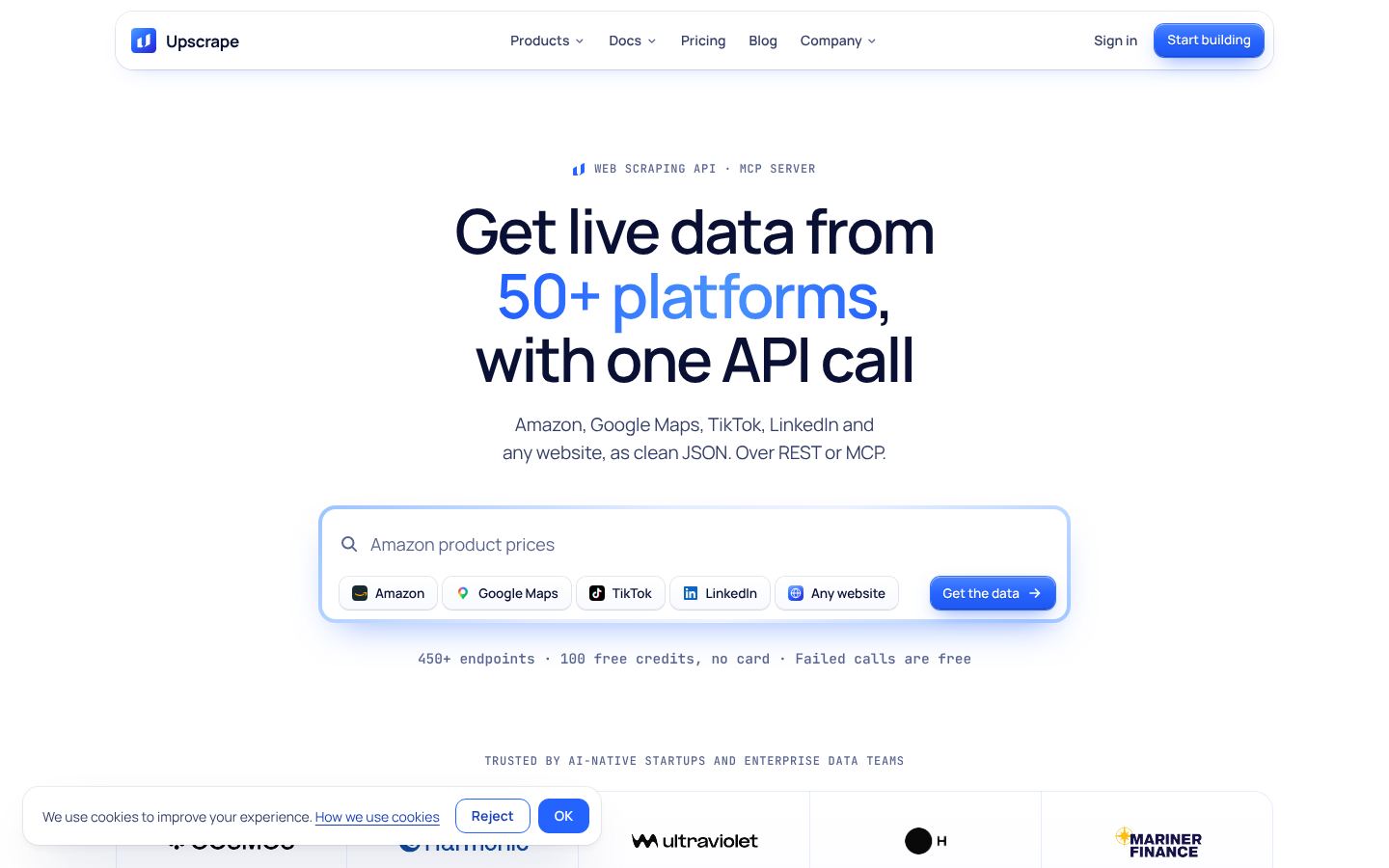
What is Upscrape?
Prebuilt data endpoints for 58 platforms, including Amazon, Reddit, Google Maps, and UK and Indian grocery apps, plus a generic page-to-markdown API, over REST and a hosted MCP server.
Our verdict
Upscrape sells per-platform data endpoints rather than a general scraper. You ask for something like `amazon.products.search` or `googlemaps.search` and get structured JSON back without writing selectors. Its machine-readable index lists 58 platforms and roughly 475 endpoints. Amazon, Reddit, YouTube, TikTok, and LinkedIn are there, along with an unusual run of UK supermarkets (Tesco, Sainsbury's, Asda, Ocado) and Indian quick-commerce apps (Blinkit, Zepto, Swiggy Instamart). Depth varies by platform. X, for example, only returns public posts you already have the ID for. For sites outside the catalog, there are five generic tools for extraction, markdown, crawling, sitemaps, and screenshots, and pages that need JavaScript get opened in a real browser.
If you are building an agent product, the MCP server is worth a look. It does not load hundreds of tool schemas into context. By default the agent gets a few general tools: search the catalog, describe an endpoint, prepare a call (validates the input and quotes the exact price), execute, and fetch or export results. Only a successful execute costs credits. You can pin specific platforms as named tools, or scope a connection to read-only or to chosen platforms, and sign-in uses OAuth so nobody pastes a key.
The company behind it is small. The legal entity is Sylego LLC, and Massive's marketplace listing gives 2024 as its founding year. We found no funding or published uptime figures, and SLAs are offered only on enterprise contracts. Every endpoint depends on its target site staying scrapeable, so run the free credits against the exact platforms you need before you commit a roadmap to them.
Categories:
Web scraping APIs abstract away the hardest parts of web data collection: JavaScript rendering, anti-bot detection, proxy rotation, and data parsing. Instead of building and maintaining your own scraping infrastructure, you send a URL and receive clean, structured data back. For AI applications, many of these APIs now return LLM-ready markdown or structured JSON.