How much does Tabstack cost?
Tabstack is freemium. New accounts get 10,000 free credits, then pay-as-you-go runs $0.35 per 1,000 credits with no monthly fee. A markdown extract costs about 10 credits, a JSON extract about 50, an automate action 100, and a research run 250 to 350. The Team plan is $99 per month for 500,000 credits, and Pro is $499 per month for 3 million credits.
Is Tabstack open source?
No. Tabstack is a proprietary, Mozilla-built managed API, and you cannot self-host it. Its four endpoints (extract, generate, automate, research) run only on Tabstack's hosted infrastructure. If you need code you can run on your own servers, Tabstack does not fit. Consider a self-hostable option like Firecrawl's open-source edition instead.
Does Tabstack render JavaScript?
Yes. Tabstack uses adaptive routing. A request starts as a raw HTTP fetch and escalates to a full browser only when the page needs JavaScript execution or hydration to expose its content. That keeps simple pages cheap while still handling client-rendered sites. Requests identify with a Mozilla Tabstack User-Agent, robots.txt directives addressed to that agent are honored, and Mozilla commits to not training models on the collected content.
What is Tabstack best used for?
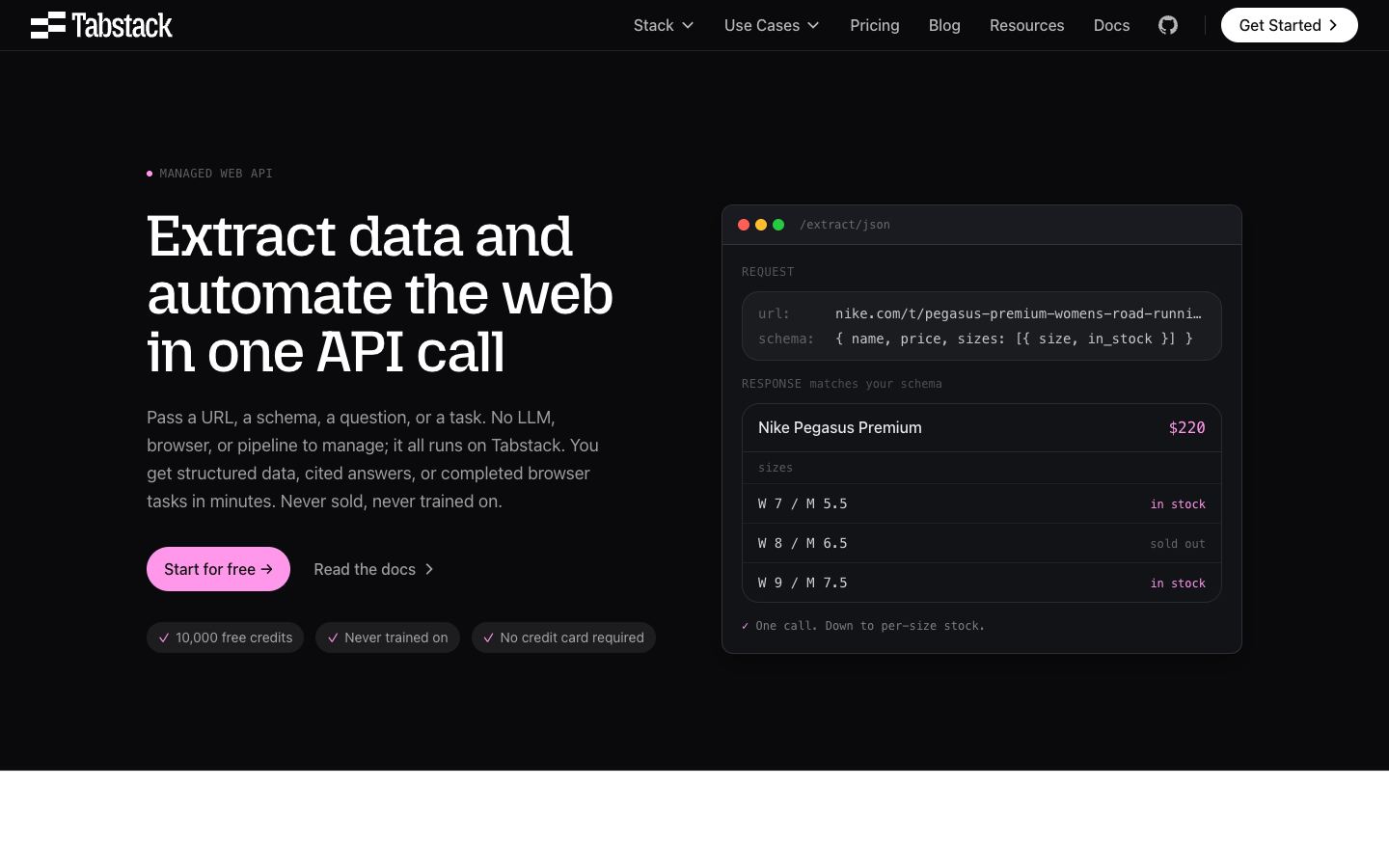
Tabstack suits AI product teams that want web access for agents without building their own scraper, browser pool, or LLM pipeline. You pass a URL, schema, question, or plain-language task and get back markdown, structured JSON, completed browser actions, or cited research answers. It fits builders who value the privacy posture, ephemeral data handling, and no-model-training commitment. It is less suited to teams needing on-premise control or a mature, long-proven platform.
Tabstack vs Firecrawl: which should I choose?
Their surfaces overlap closely. Both offer extract, structured output, and agent-oriented web access. Firecrawl is more established and has an open-source edition you can self-host, which matters if you need infrastructure control. Tabstack is Mozilla-built with adaptive HTTP-to-browser routing, explicit no-training and ephemeral-data handling, plus a research endpoint that returns cited answers. Tabstack is newer and in public early access, so test both on your actual workloads and latency before committing.
What are the best alternatives to Tabstack?
The closest alternative is Firecrawl, which covers similar extract and agent use cases and adds a self-hostable open-source option. Jina AI offers a reader API for turning URLs into LLM-ready text, often at lower cost for simple fetches. Browser Use targets agentic browser automation when you need fine-grained control over clicks and navigation. Kadoa focuses on no-code structured extraction with schema maintenance. Match the choice to whether you prioritize automation, research, or self-hosting.