Is Skyvern open source?
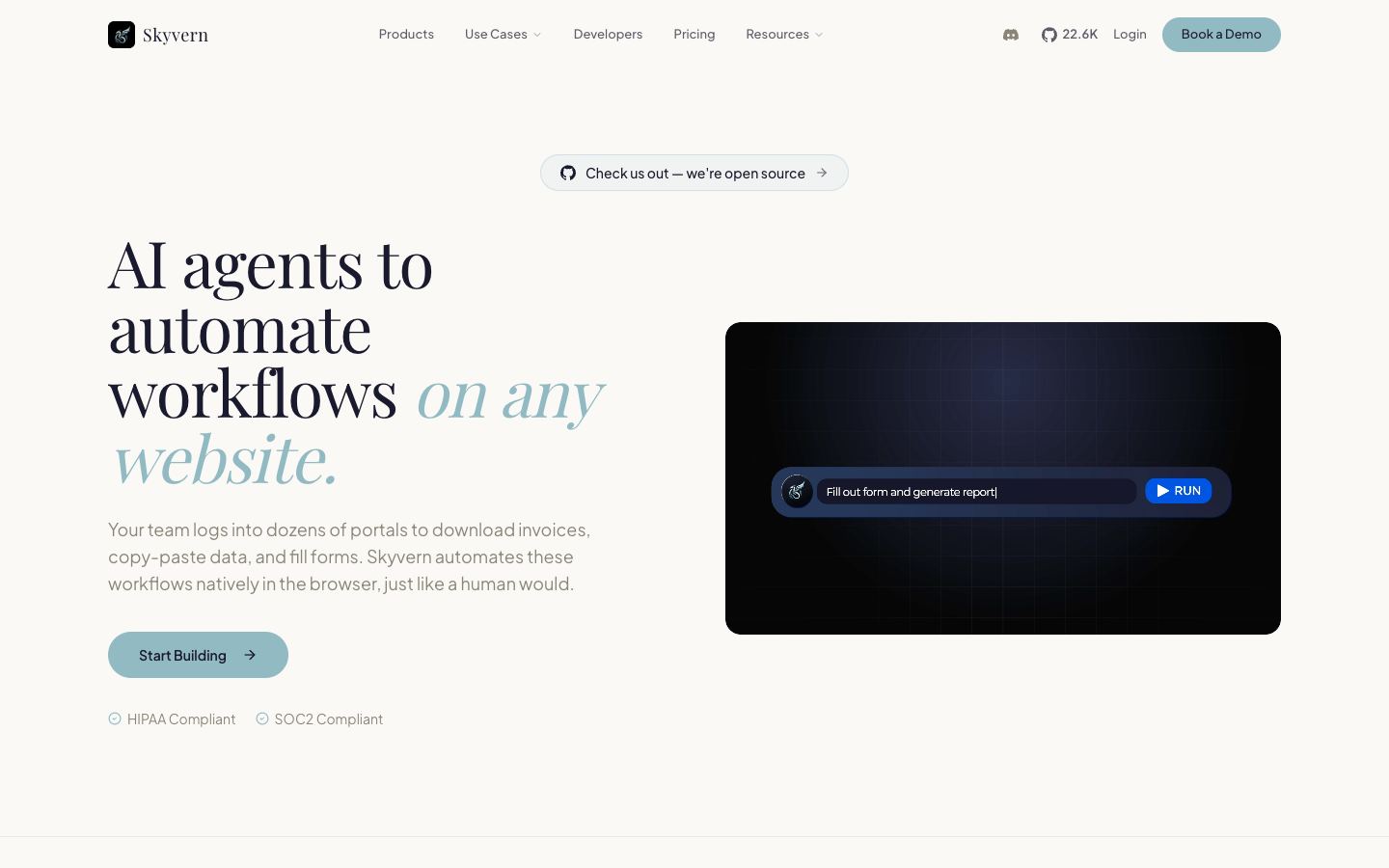
Yes. Skyvern is open source, with its code published on GitHub, and the company is YC-backed. You can run the agent yourself or use the managed cloud option at skyvern.com. The open-source core lets you inspect how its computer-vision and LLM workflow operates. When you self-host, you supply your own model API keys and absorb the per-interaction inference cost yourself.
Can Skyvern be self-hosted?
Yes. Because Skyvern is open source, you can deploy it on your own infrastructure instead of relying on the hosted cloud. Self-hosting gives you control over data and browser sessions, which matters for regulated workflows. You still pay the LLM and vision-model costs per interaction, and you take on the operational work of running and scaling the browser automation stack yourself.
How much does Skyvern cost?
Skyvern uses freemium pricing. There is a free tier with monthly credits, plus paid plans that add more credits, concurrent runs, and team features, with custom enterprise pricing above that. Check skyvern.com/pricing for current numbers, since the tiers change. If you self-host the open-source version, the main cost shifts onto your own LLM and vision-model usage rather than a subscription.
What is Skyvern best used for?
Skyvern fits complex browser workflows that need genuine page understanding: multi-step forms, dynamic interfaces, logins, and sites whose layouts change often. It uses computer vision to read the page the way a person would rather than relying on brittle CSS selectors or XPath. It is a poor fit for high-volume bulk extraction, where the visual processing makes it slower and more expensive than a traditional HTML scraper.
How does Skyvern compare to Browser Use?
Both are open-source agents that drive a real browser with an LLM, so both render JavaScript and handle dynamic pages. Skyvern leans heavily on computer vision to interpret what is on screen, which helps on visually complex or frequently changing sites. Browser Use is a common alternative when you want a lighter agent framework. Evaluate them on reliability for your specific workflows and on per-run inference cost.
What are the best alternatives to Skyvern?
The closest alternatives are Browser Use and Stagehand, both open-source agentic browser tools that render JavaScript and produce structured output. Pick Browser Use or Stagehand if you want a lighter agent framework to embed in your own application. Diffbot is a different model: a managed extraction API better suited to large-scale structured data pulls than to the interactive, vision-driven workflows where Skyvern is stronger.