Is Marginalia Search free to use?
Yes. Marginalia Search is free, with no advertising and no personal-data collection. Running costs are low, and the project is funded through donations, grants, and commercial API deals rather than venture capital. There are no usage tiers or paywalls on the public search interface. An API exists if you want programmatic access, and the commercial API arrangements help support the project financially.
Is Marginalia Search open source?
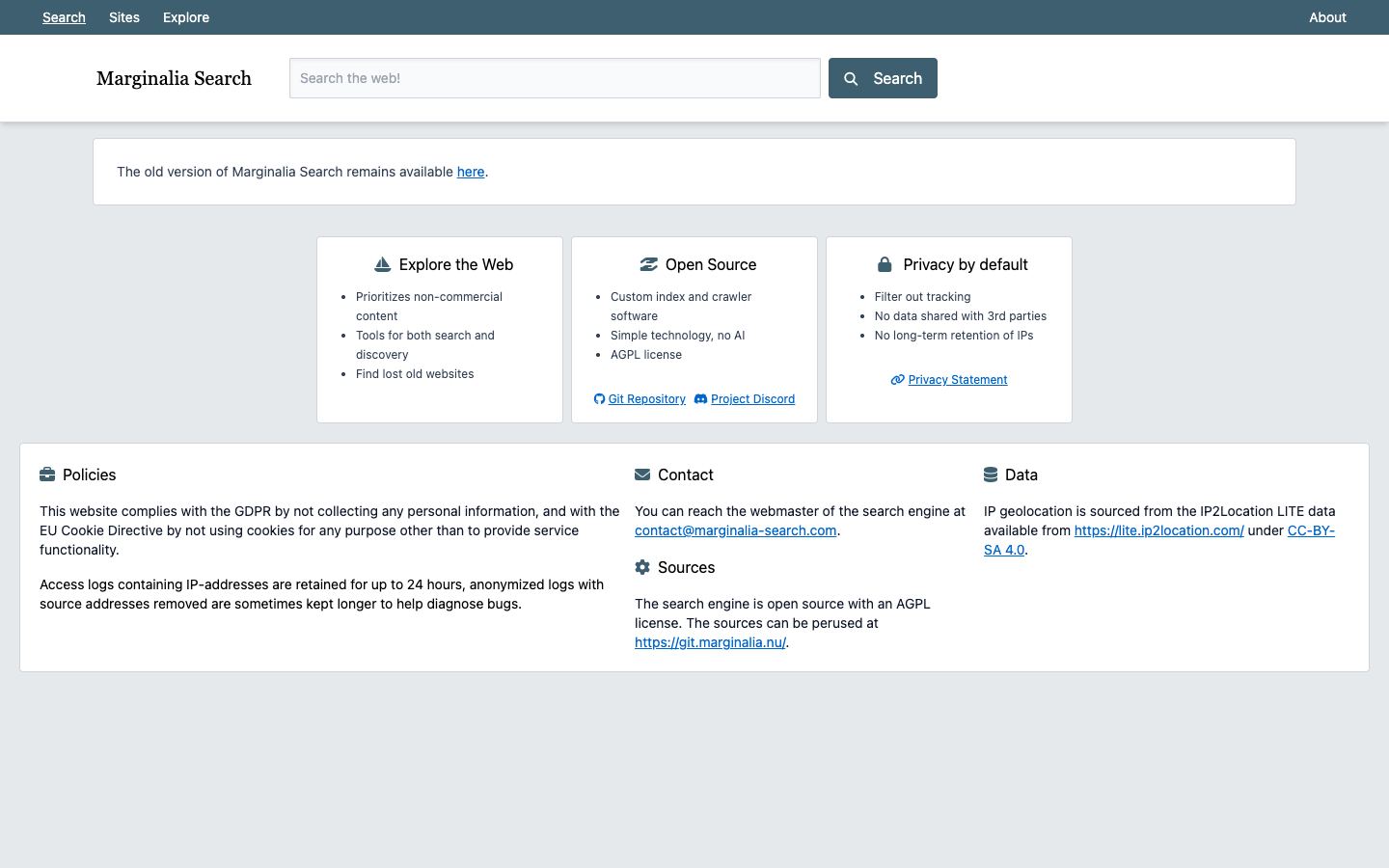
Yes. Marginalia Search is open source under the AGPL 3 license, with sources published on GitHub (github.com/MarginaliaSearch), where the older git.marginalia.nu address now redirects. It is principally developed and operated by one person, Viktor Lofgren, in Sweden. The codebase exists partly to develop alternative ways of discovering content on the web. It is a passion project rather than a commercially backed product or production infrastructure.
Can I self-host Marginalia Search?
Yes. Because the engine is AGPL-licensed, you can run your own instance. A full deployment needs meaningful hardware and may lean heavily on disk caching, while a smaller developer setup with a reduced index runs on more modest machines. Self-hosting suits experimentation rather than serving the full public index at scale.
Does Marginalia Search render JavaScript?
No. Marginalia uses its own crawler aimed at text-oriented websites, with an emphasis on small, old, and independent pages plus blog and RSS-feed discovery. It does not render JavaScript or extract data from script-heavy commercial applications. That focus is deliberate. It surfaces text-heavy content that mainstream engines deprioritize, so it is the wrong fit if you need to crawl dynamic, client-rendered sites.
What is Marginalia Search best used for?
It is best for discovering small, personal, text-heavy websites and the older, non-commercial web that Google buries. People use it for research, finding independent blogs, or surfacing unusual content. It is not built for business or commercial search, since the index deliberately excludes commercial pages. Treat it as a discovery tool and a passion project, not as production data infrastructure for an AI product.
How does Marginalia Search compare to Mojeek?
Both are independent search engines outside the Google and Bing ecosystem, but they differ in intent. Marginalia favors small, old, non-commercial, text-heavy sites and is open source and self-hostable. Mojeek runs its own broad crawler and index as a general-purpose privacy search engine, so it covers commercial results Marginalia excludes. Choose Marginalia for old-web discovery, and Mojeek for broader, more conventional coverage.