serp.fast

Search, deep search and cloud browsers behind one API key

Nathan Kessler
By Nathan KesslerUpdated

Each tool is evaluated against our methodology using public docs, vendor demos, and hands-on testing.

Some links on this page are affiliate links. We earn a commission if you sign up – at no additional cost to you. Our editorial assessment is independent and never paid. How we review.

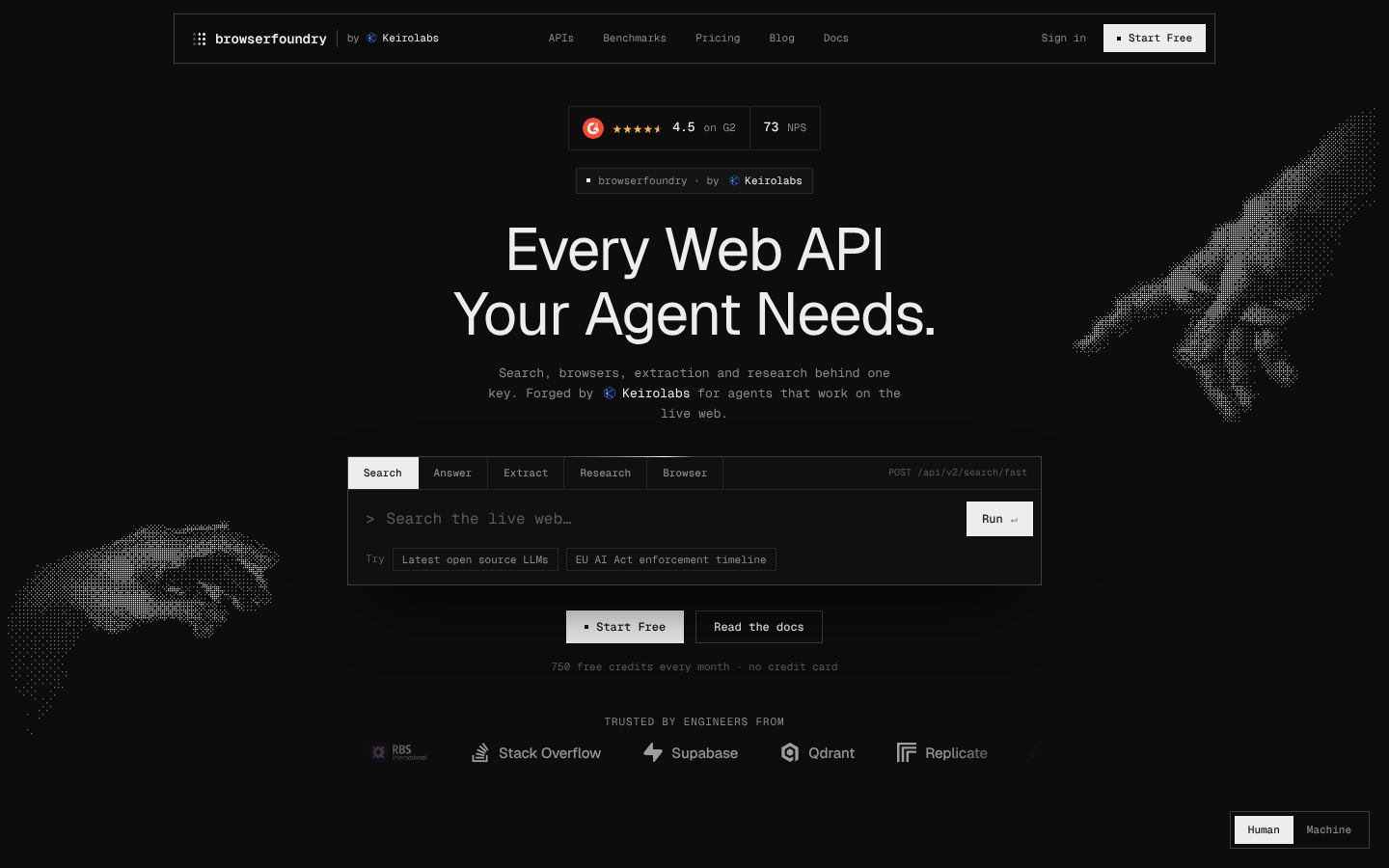
browserfoundry website

What is browserfoundry?

Keirolabs' web data API for agents: search, cited answers, deep search, extraction and leased Chrome sessions on one key and one credit balance. It is the product behind the Keiro deep search endpoint.

Our verdict

browserfoundry is the developer brand of Keirolabs, a small search company whose headline product is the Keiro deep search endpoint. The pitch is breadth on a single meter: cheap lite search, search with full-page markdown, a cited answer endpoint, multi-step research, URL extraction, Google results as JSON, and Chrome sessions you lease by the minute. Everything is also exposed through one MCP server. Lite search starts at $0.10 per 1,000 on the $29.99 Essential plan, and the free tier gives 750 credits a month. The SimpleQA claim needs a careful read. Keirolabs reports 95.3% for deep search on a seeded 1,000-question sample, but its test only checks whether the gold answer string appears somewhere in the returned pages, and a hand audit of misses added 7.6 points to a raw 87.9%. Rival scores come from answering pipelines with a reader model and a judge, so the gaps are directional, as Keirolabs itself says. The harness and every payload are on GitHub, which is more than most vendors offer. The company is young and has no disclosed funding, so a buyer should weigh the low price against that.

Categories:

AI search APIs are the infrastructure layer that gives large language models access to current web information. Unlike traditional search engines, these APIs return semantically relevant, structured results optimized for retrieval-augmented generation (RAG) and AI agent workflows. They are used by AI products that need to answer questions about the real world beyond their training data.

Share:

Embeddings-based neural search that finds semantically related pages

FreemiumMar 2026AI-Native Search APIs

Real-time search API built for AI agents and RAG pipelines

FreemiumMar 2026AI-Native Search APIs

Proprietary web index built for deep multi-hop agent research

FreemiumMar 2026AI-Native Search APIs

How browserfoundry compares

Tavily

Tavily is the established agent search API with wide framework support, a safer pick when vendor maturity matters more than price per call.

Exa

Exa runs its own embeddings-based index and also sells a deep search tier, with a longer public track record.

Parallel AI

Parallel covers similar ground (search, extraction, deep research) with far more funding and a heavier enterprise focus.

Frequently asked questions

What is the difference between browserfoundry, Keirolabs and Keiro?

They are one company and one API. Keirolabs is the company. browserfoundry is the name it uses for its developer product: the search, extraction, research and browser endpoints that share one key and one credit balance. Keiro is the name attached to the search engine and its deep search endpoint, the one behind the SimpleQA claim. If you sign up on either site you get the same platform, the same plans and the same credits.

How much does browserfoundry cost?

The free tier gives 750 credits every 30 days with no card. Paid plans are $29.99, $49.99 and $99.99 a month, with 11,250, 33,750 and 112,500 credits. Each endpoint draws a different number of credits: lite search is the cheapest at $0.10 per 1,000 on Essential, search with content costs more, and deep search costs 5 credits. Keirolabs lists deep search at $4.44 per 1,000 requests. One-time credit packs last six months.

Is the 95.3% SimpleQA score comparable to Tavily or Exa?

Only roughly. Keirolabs scores retrieval: a question counts if the gold answer text appears anywhere in the returned snippets or pages. The raw substring score was 87.9%, and a hand audit of misses raised it to 95.3%. The Tavily, Exa and Parallel numbers it compares against were produced by other harnesses, where an LLM reads the results and a judge grades the answer. Keirolabs calls the gaps directional, and that is the right way to read them.

Does browserfoundry render JavaScript?

Yes. Pages are fetched and rendered on Keirolabs' side, and deep search reads each candidate page in its final rendered state. For anything a search result can't cover, the browser API leases a real Chrome session with its own fingerprint and a fresh IP, billed only while the session is open. That makes it one of the few search APIs that also sells browser sessions under the same account.

How fast is Keiro deep search?

It is slow next to plain search. In Keirolabs' own SimpleQA report, median latency for deep search was 14.7 seconds, and it read an average of 7.9 pages per question. That is the price of reading every candidate page end to end. For interactive chat, the fast search endpoint, which returns ranked results in about a second, is the better fit. Deep search suits verification steps and research agents that can wait.

What are the best alternatives to browserfoundry?

Tavily is the most common choice for agent search and has the widest framework support. Exa sells its own deep search tier on an embeddings-based index. Parallel offers search, extraction and multi-step research with much larger backing. Pick browserfoundry if price per call and having search plus browsers on one bill matter most, and you are comfortable buying from a small, newer vendor.

Visit

browserfoundry

Visit