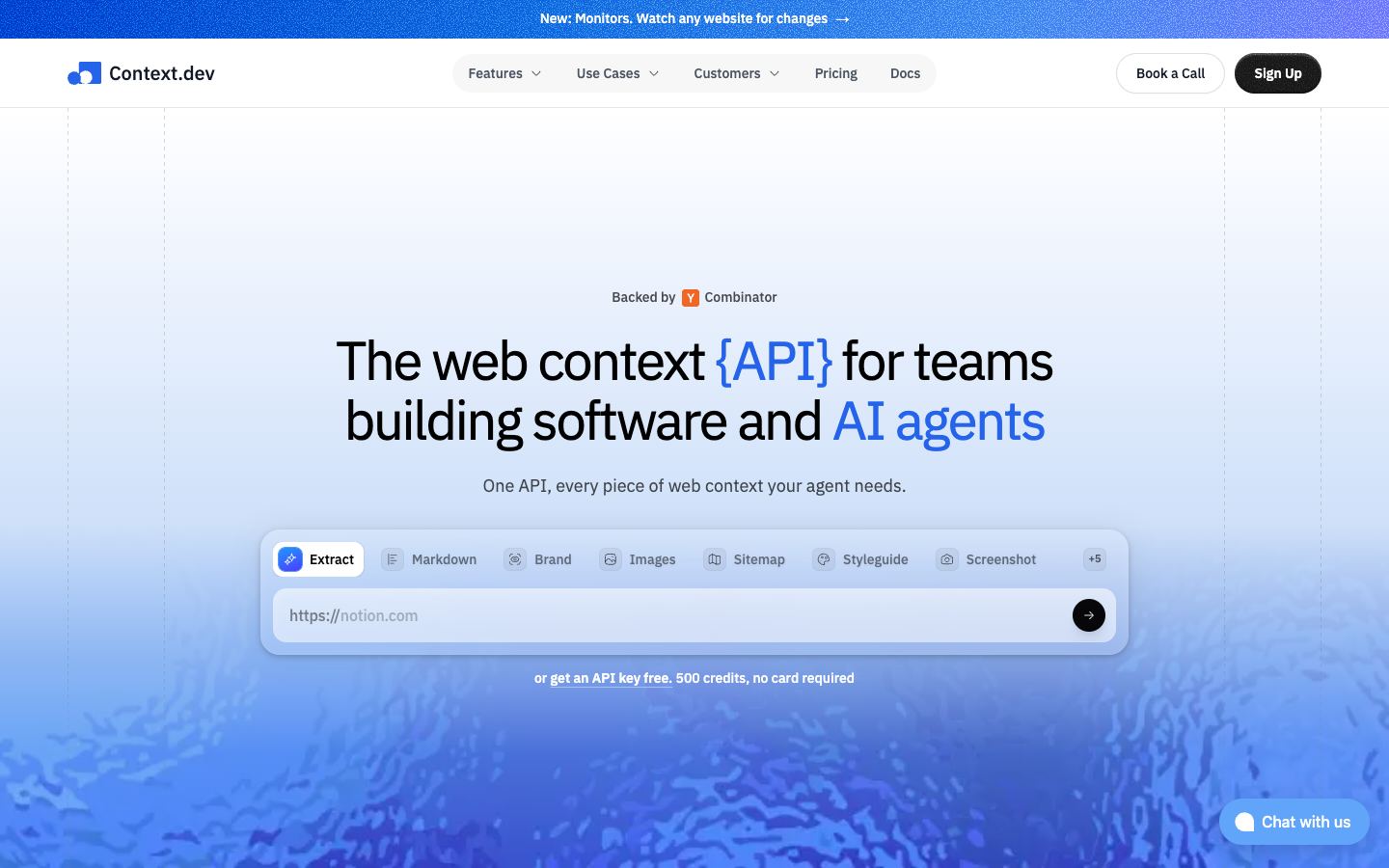
What is Context.dev?
Web context API for AI agents that turns any URL into LLM-ready markdown or JSON-schema structured data, with a brand-data layer (logos, colors, fonts) from its Brand.dev origin.
Our verdict
Context.dev packs most of this category's product surface into one credit-metered API: scrape to HTML or markdown, screenshots and image pulls, sitemap and full-site crawls, a web-search endpoint, and JSON-schema structured extraction. None of its direct peers bundles the brand-intelligence layer it kept from its Brand.dev days: logo, color, font, and styleguide extraction, a logo CDN, and NAICS/SIC industry classification. JS rendering, anti-bot bypass, and proxies cost the standard one credit per page, with no surcharges. There is an MCP server, an agent quickstart that lets a coding agent register its own API key, and official SDKs for TypeScript, Python, Go, and PHP.
The caveat is age and size. This is a solo-founder company (Yahia Bakour, ex-Amazon, who previously co-founded the acquired StockAlarm.io) in the Y Combinator Summer 2026 batch, rebranded from Brand.dev in March 2026, with no disclosed funding beyond YC and SOC 2 Type II still in progress. The customer logos on the homepage (Mintlify, daily.dev, Chatwoot, Similarweb, Klarna) are self-reported; the detailed case studies name real people at Mintlify, SiteGPT, and ION, but we could not independently corroborate the larger enterprise names. The 96%+ first-attempt success rate is likewise a vendor claim.
Worth evaluating if you want markdown conversion, schema extraction, and brand or company enrichment from a single API with a $25 entry price, especially where the brand-data layer would otherwise mean a second vendor. For crawl-and-extract alone, Firecrawl remains the more established default in this category, with the bigger community and the longer production track record.
Categories:
Web scraping APIs abstract away the hardest parts of web data collection: JavaScript rendering, anti-bot detection, proxy rotation, and data parsing. Instead of building and maintaining your own scraping infrastructure, you send a URL and receive clean, structured data back. For AI applications, many of these APIs now return LLM-ready markdown or structured JSON.