How much does AgentQL cost?
AgentQL uses a freemium model. A free tier lets you try the API without paying, and there is a free trial with a batch of API calls and no card required. Paid tiers move to a subscription with a monthly allotment of API calls plus metered remote browser time, and usage past the allotment is billed per call. Enterprise pricing is custom and covers managed cloud or on-premise deployment. Check the pricing page for current figures before you budget.
Is AgentQL open source?
No. AgentQL is a hosted service from TinyFish, and the query engine runs on its own API rather than as code you can read or change. The client SDKs and Playwright integrations on GitHub are published openly, so the wrappers you call are available, but the extraction engine behind them is closed. Plan for vendor dependency the same way you would with any hosted extraction API.
Can AgentQL be self-hosted?
Not on the standard plans. AgentQL is delivered as a cloud API, and extraction runs through TinyFish's hosted remote browsers, so the regular tiers cannot run on your own infrastructure. On-premise deployment is offered only under custom Enterprise contracts. If running everything inside your own environment is a hard requirement, an open-source library like ScrapeGraphAI is a closer fit.
Does AgentQL render JavaScript and handle dynamic pages?
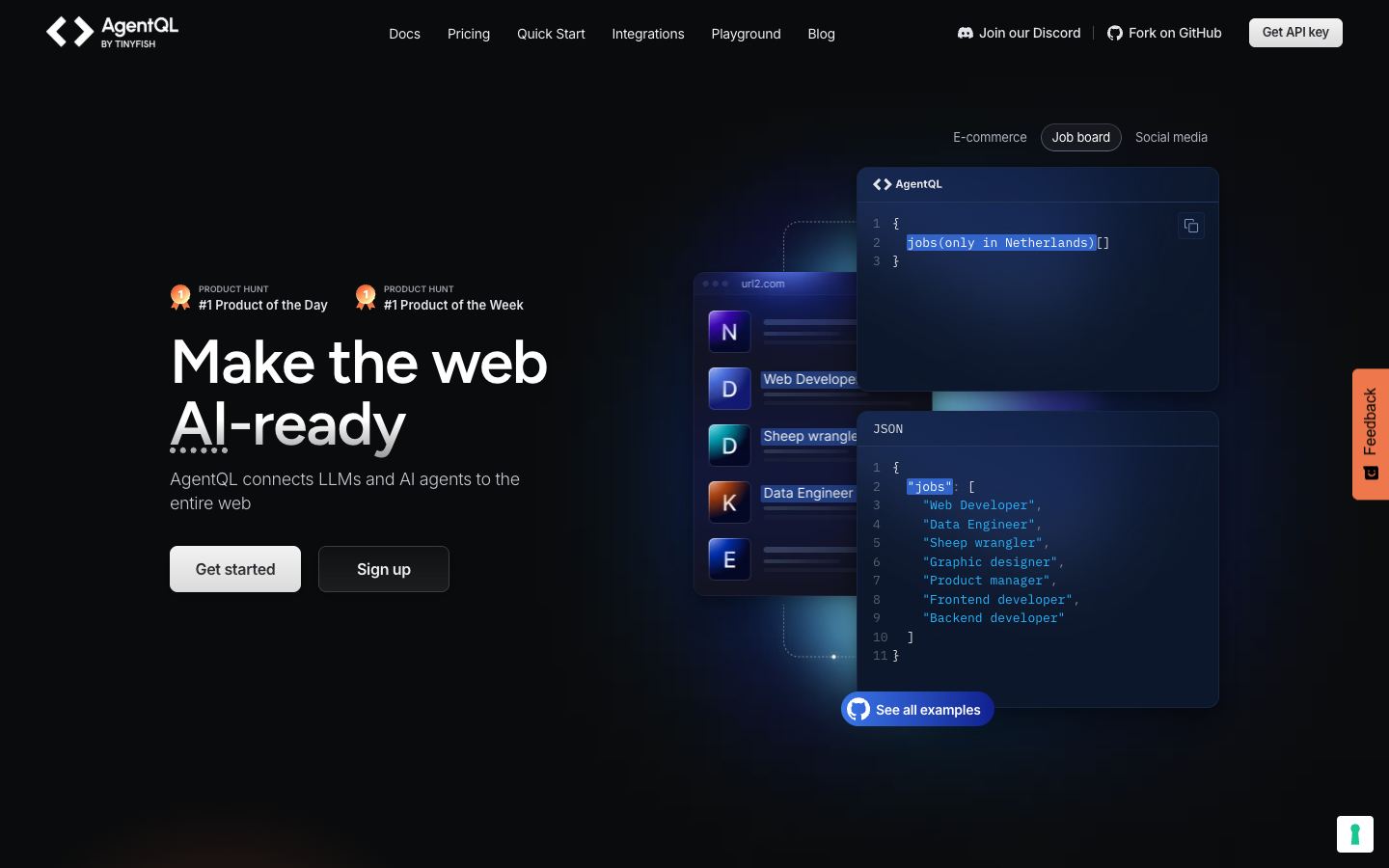
Yes. AgentQL extracts through Playwright and hosted remote browsers, so it loads JavaScript-heavy and client-rendered pages before reading them. Because queries describe elements by meaning rather than by CSS path, extractions tend to keep working when a site changes its markup. It returns structured JSON shaped by your query, which makes the output predictable to parse downstream.
How does AgentQL compare to ScrapeGraphAI?
Both extract structured web data using AI, but the interface differs. AgentQL uses a typed query language where you name the fields you want, which gives more deterministic results than a free-form prompt. ScrapeGraphAI is open source and prompt-driven, so it can be self-hosted and avoids a query syntax to learn. Choose AgentQL for structured precision on a hosted service. Choose ScrapeGraphAI when you need local control or open code.
What is AgentQL best used for?
AgentQL suits teams that want repeatable, structured extraction from dynamic sites without writing fragile selectors. The query language sits between CSS or XPath and plain natural language: more precise than a prompt, more adaptable than a hardcoded path. It fits product and data teams feeding clean JSON into AI applications. The tradeoff is a custom syntax to learn, which natural-language tools such as Diffbot or Stagehand avoid.